COPIC MARKERS for Fashion sketching:
MARKER PAPER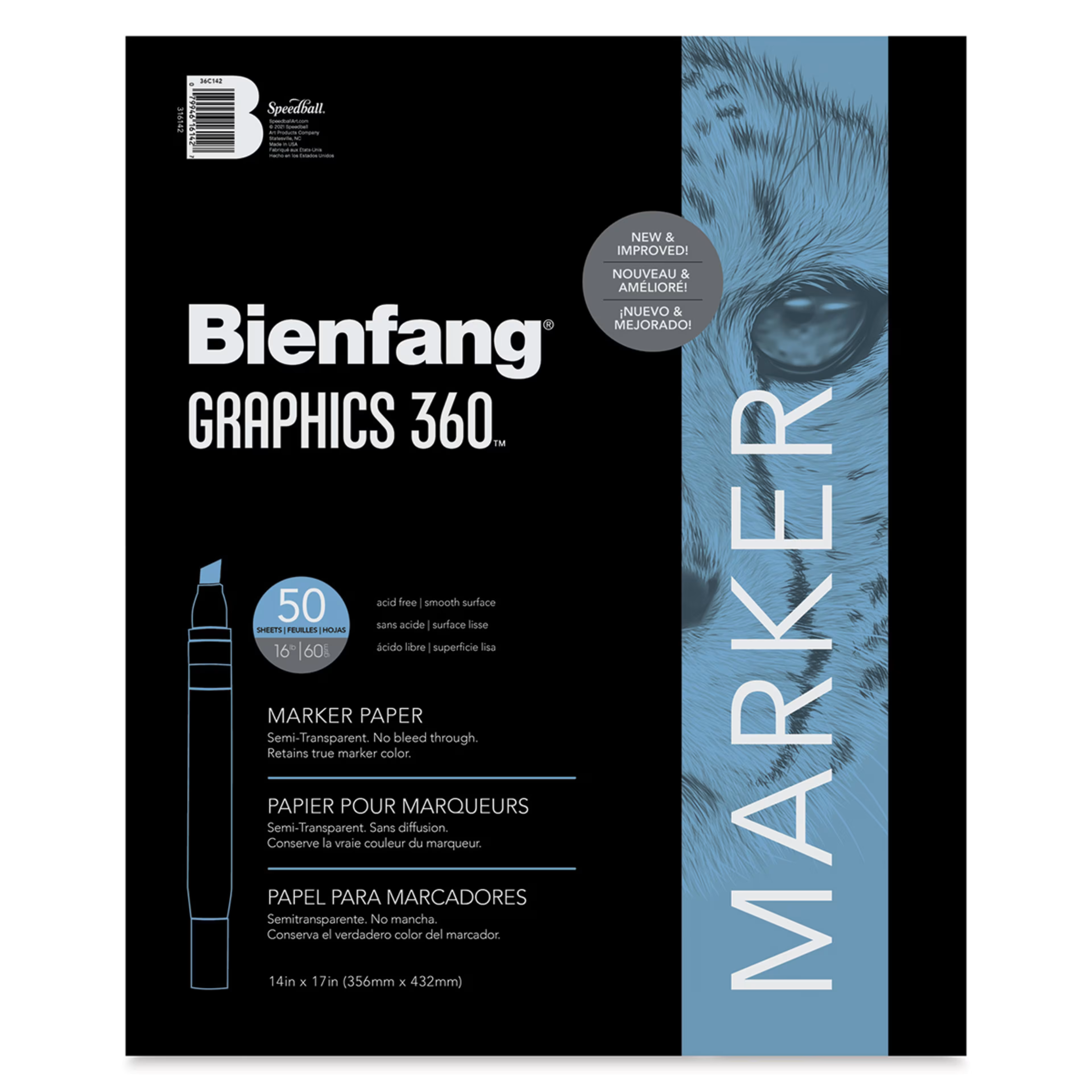
Before we can talk about your Copic markers for fashion illustration, we have got to set you up with the right paper.
AVOIDING BLEED-THROUGH

Marker paper is notoriously sheer, thin, and often bright-white and smooth.
That’s why I stayed away from Copic markers and other markers for decades. I was so used to the rich, velvety texture of gouache and pencil on watercolor paper. Markers made my fashion drawings feel flat and thin because of the paper as well as the ink.
On a more positive note, MARKER PAPER is made for markers. So your Copic markers are happier and longer lasting on marker paper and thus, you are happier too.

CHARACTERISTICS OF MARKER PAPER
They won’t bleed through, they’ll glide beautifully aross the page, and your Copic markers won’t dry up in the middle of a fashion illustration because the paper absorbs so little ink along the way.
Using alcohol design markers on any other paper can be a bleeding, messy disaster as you probably already know.

Extinct Papers
In just the past few years with the overwhelming wave of digital software across all design industries, I’m sorry and sad to say that my favorite marker papers which were all made from 100percent cotton rag have all disappeared from the market, so I can’t link them here. (Daler &Rowney , Strathmore and Bienfang all offered wonderful papers that have been replaced with different qualities).
When Strathmore put the rag paper to rest, they released a “replacement”- their new “MARKER PAPER” is heavyweight, like a cardstock, and supposedly special for markers. While it resists bleedthrough, it’s too heavy and high quality to use for development/ process type sketches. It seem to be for final, presentation type art and illustrations.
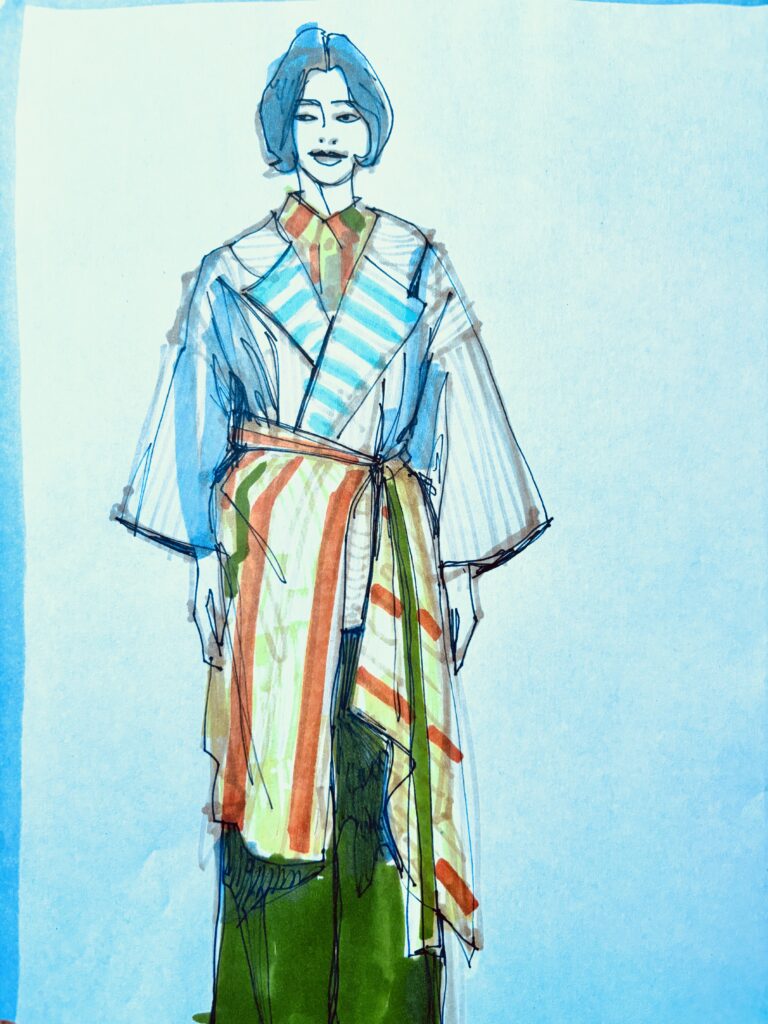
I used it here (and then layered colored pencils on top):

Their other option now is their “Layout Bond”, but it isn’t made from cotton.
I used it here:
SLICK AND SMOOTH
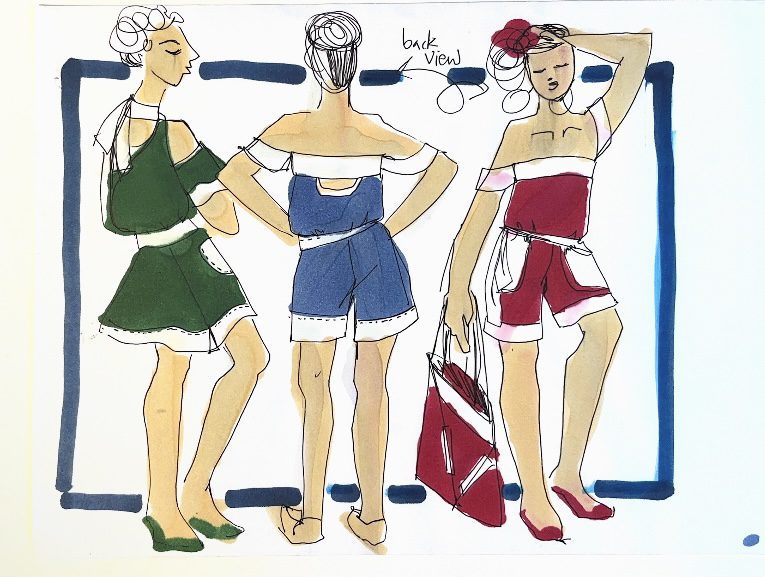
It’s like having fine silk replaced with polyester- I miss the cotton papers!
My heart is broken. Yet, if I’m illustrating something synthetic or very modern and slick, that can actually be the look i’m going for.

MODEL DRAWING
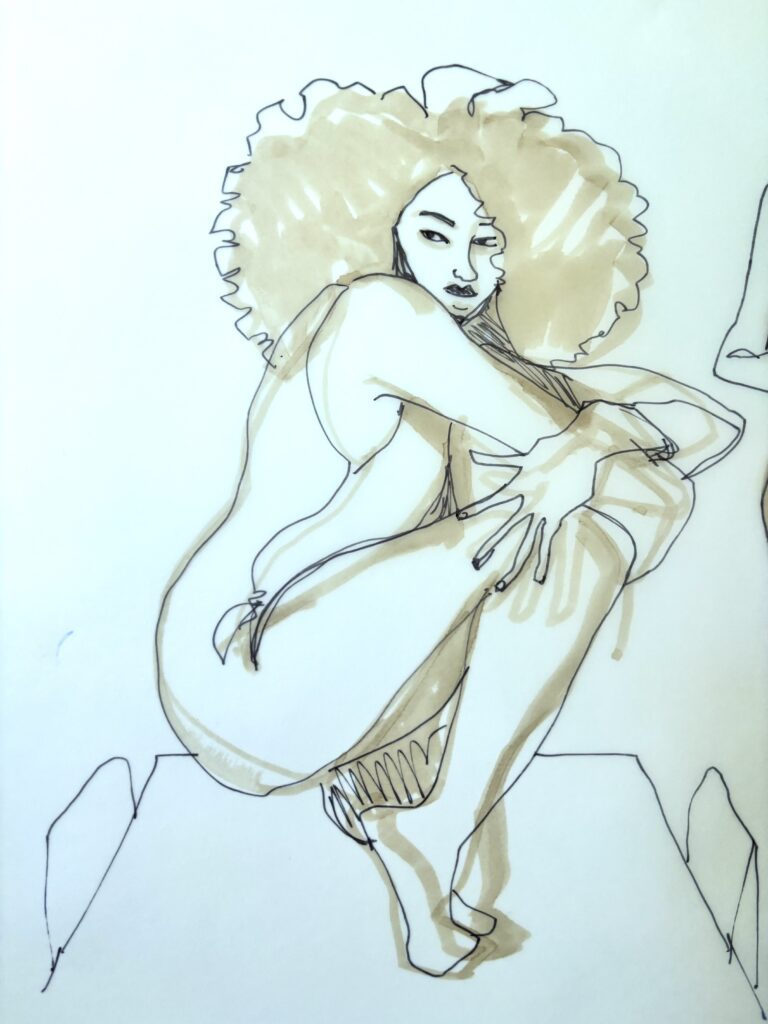
I still find that a good quality marker paper or any good paper at all, has such a nice quality to it that I even use it for working with colored pencil or graphite, or watercolor markers sometimes –-because its surface is so lovely!

SHEER PAPER TECHNIQUES
While the thin quality of the marker paper I use with my Copic markers is one of the things that bothers me for fashion illustration, especially when I want to illustrate rich, cozy, thick or textural fabrics like handwoven or knitted items, or things like tweed, velvet, cordury, etc… (what do you think, I tried in the childrenswear collection below?).

The sheerness of marker paper can become an advantage when you make TRACING part of your illustration or design process.
For the class I was teaching, above, we all used the same body to sketch onto, placing it under the marker paper for consistent proportions..
Being able to lay a sheet of marker paper over another sketch or drawing to trace a new rendition or idea referencing the first one is so easy with marker paper.
THIS IS ALSO SO HELPFUL FOR SKETCHING AND DESIGNING WITH FLATS.
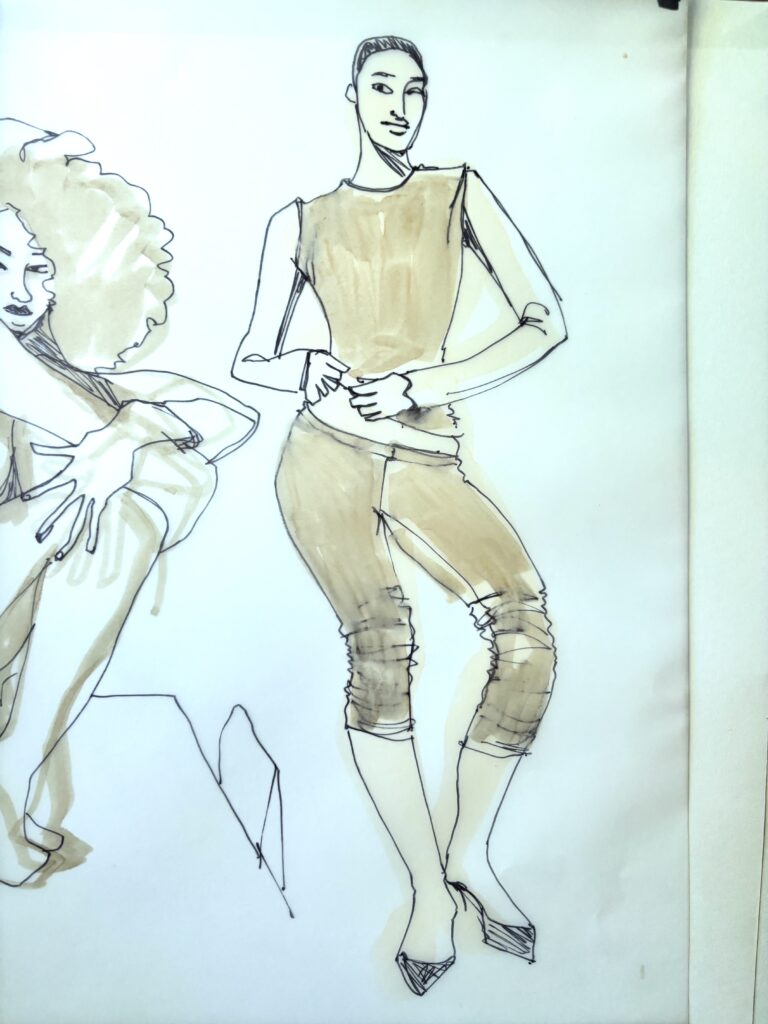
BELOW, I used heavy tracing vellum, not marker paper, but I wasn’t tracing anything. I was using it for the unique surface texture it has.
TRACEABILITY
It facilitates tracing processes that can really come in handy and be creative for fashion sketching.
I especially love the translucent quality of marker paper when I’m sketching flats.
Depending on the colors, markers, and tips you use, and how much you layer them, you can get different feel from the markers, from washy to dense.

Alternately, TRACING PAPER while often bleedproof itself, is USUALLY way TOO SHEER to be useful, while marker paper has translucency but still filters out enough of the “noise” from the page under it.)
I’m adding a note now because I discovered FABRIANO TRACING PAPER. It’s an incredibly heavy weight vellum and is ABSOLUTELY DELIGHTFUL to use markers on, it feels like ice skating on this luscious paper, and there is ZERO bleed through. 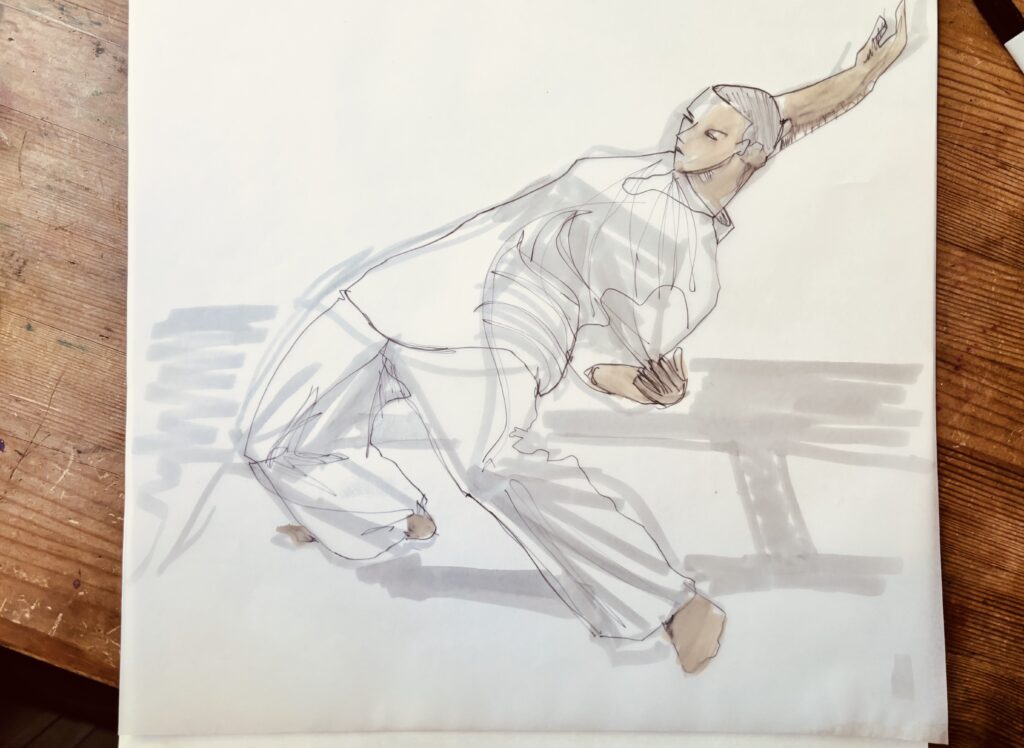
CREATIVE ILLUSTRATION with Copic Markers
 Screenshot[/caption]
MIXED MEDIA EFFECTS
I usually mix my marker technique with fine felt tip pens, graphite pencil, or colored pencils (or all of the above!).
In the example above, however, I used a mix of slightly dry and wet markers to capture the feeling of the floral dress, contrasting the skin texture from the fabric texture.
In a different situation, I used just pencil to capture the sheer white skirt below.
Still, I took advantage of the unique effect of the chisel tip of the Copic markers.

Model Drawing Practice with Copic Markers

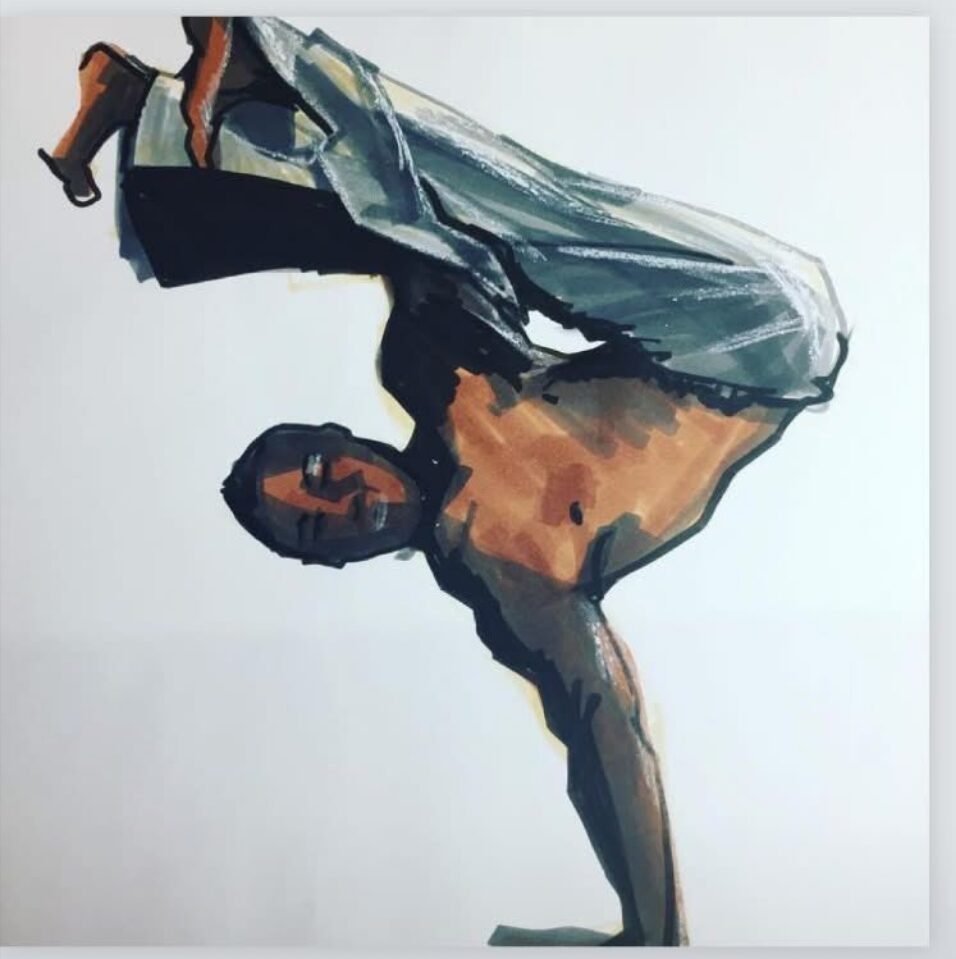
Grab your marker paper pad, and explore the wide and narrow tip strokes available on each end of Copic markers to build the figure and shade it.
Copic Markers have two tips:
A soft, bendy brush tip that tapers off, and a chisel tip which is often QUITE hard.
I always find that the characteristics of each of these tips forces me to draw differently than with any other media!
And in my opinion, live model drawing sessions are the perfect environment to get playful and open to discovering a new drawing tool as well as the new aspects of your style and technique that a new tool inspires!
A Softer or Harder tip sets the tone for the personality of the sketches.

MIXING MARKERS:
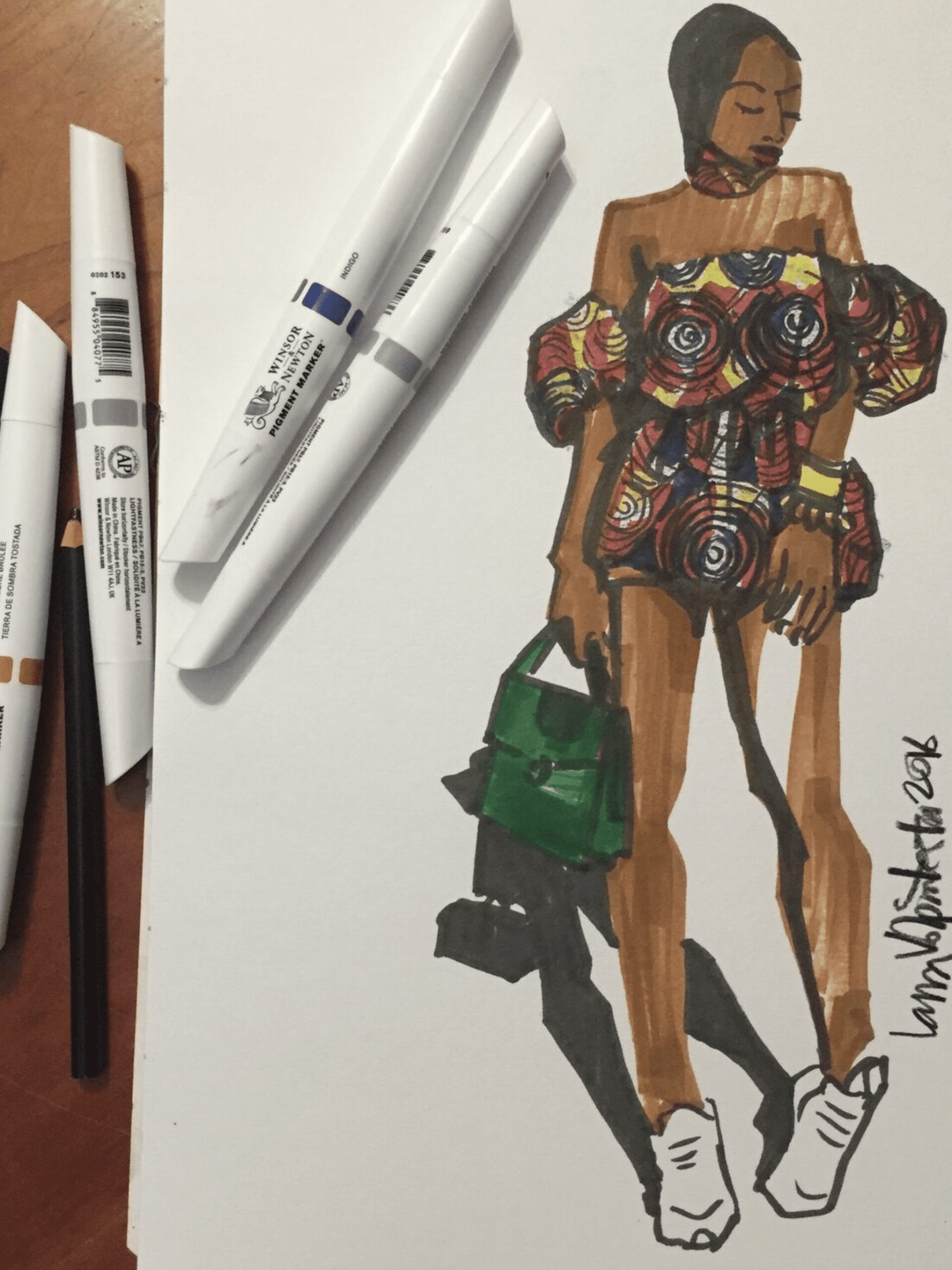
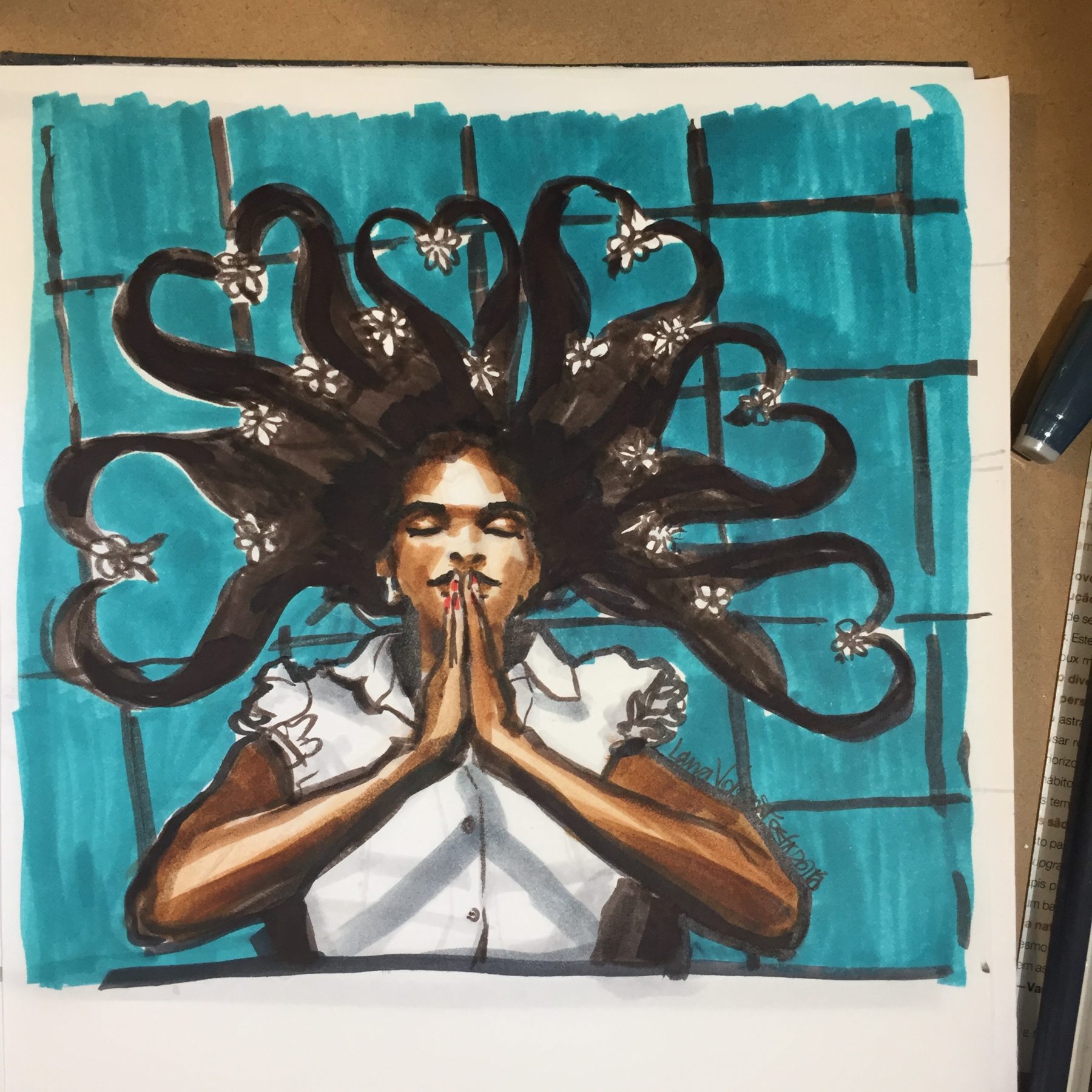
The African Fashion Wax Print fashion illustration below was photographed with Winsor and Newton’s now discontinued Pigment Markers (they were gooey and thick and wonderful) but I remember for a fact that I used a whole lot of different markers to create the print.
I find that many different qualities of markers can be used together, and thank goodness for that.
To me, the most important thing is that I have the COLOR I want!
BELOW, I cheated and used Bristol vellum for the African Wax Print fashion illustration so I could capture the dry, woven texture of the cotton fabric.
The dry effect of the marker in the skin tone gave this fashion illustration a lot of personality that I love, without using any pencils at all.
The buzz about Copic Markers for fashion is such a trend for a long time now, but it can turn into a big rabbit hole. Enjoy them, but if you can’t get your hands on them, MOVE ON, you are still an artist. No FOMO required, they are not magical. They are just another tool.
YOU are MAGICAL.
ECONOMIZING

I swore I wouldn’t get into something that costs $6-7 per Copic marker, especially because I wasn’t a big fan of marker art to begin with.
SO I MIXED.
I bought a whole bunch of markers of different prices, brands, sizes, tips.
I even bough Crayola and Tombow water -soluble markers, and I mixed them ALL up.
PROBLEMS WITH MARKERS
As a guide, mentor, and teacher, my biggest issue with markers, aside from the waste of plastic containers and the danger of them drying up at a moment’s notice,
The other thing I hated about markers in my classroom was that students WERE NOT MATCHING THE COLORS of their markers to their fabric swatches! It made it look like they didn’t really “know” color.
When you’re showing your work as a designer, then you really want want to show yourself as an expert if you have that skill in your set.
SKETCHING FROM YOUR IMAGINATION
with markers is fine, but if you are using specific fabrics and colors, make sure that you make every effort to match the textures and colors .
When working with gouache for example, you can ALWAYS
match your colors by mixing paint. Markers aren’t as easy to mix. Remember that.

RENDERING FASHION PRINTS WITH MARKER
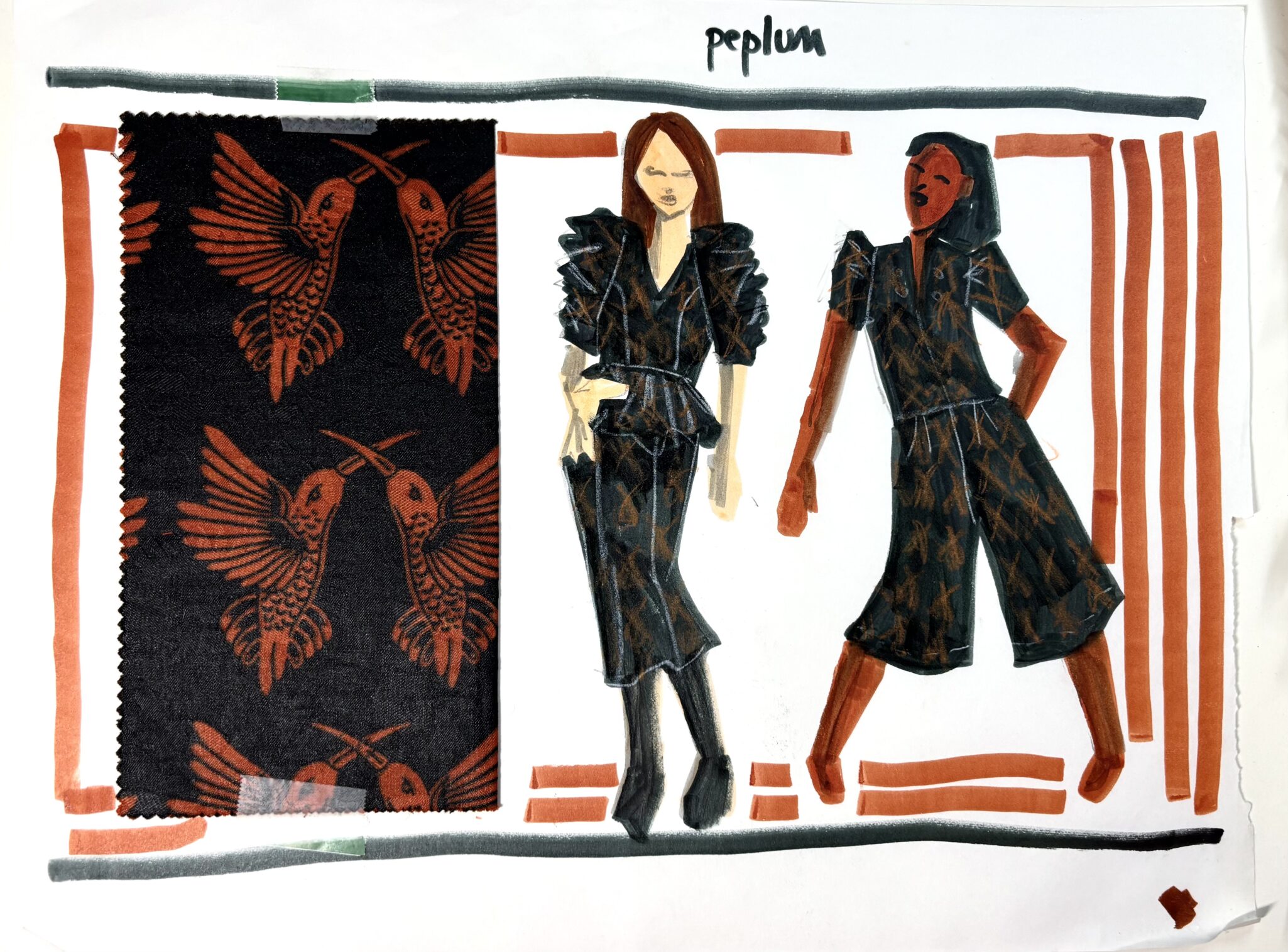
I use colored pencils or additional markers to render a print or pattern to scale over my marker fashion sketches. Above I used a white stripe and a black texture on my marker silhouettes.
In this example, I worked with black. I applied my Vlisco Dutch Bazin swatch to the page and framed my illustrations to compose the page…, then rendered the size and shape of the hummingbird motif in the matching colored pencil.
Shiny fabrics love marker
I applied the shadow with grey marker, and highlights with China marker or white Prismacolor pencil. These children’s dresses were improvised during a live online class session.

EVENINGWEAR, TAFETTA AND SATIN AGAIN!
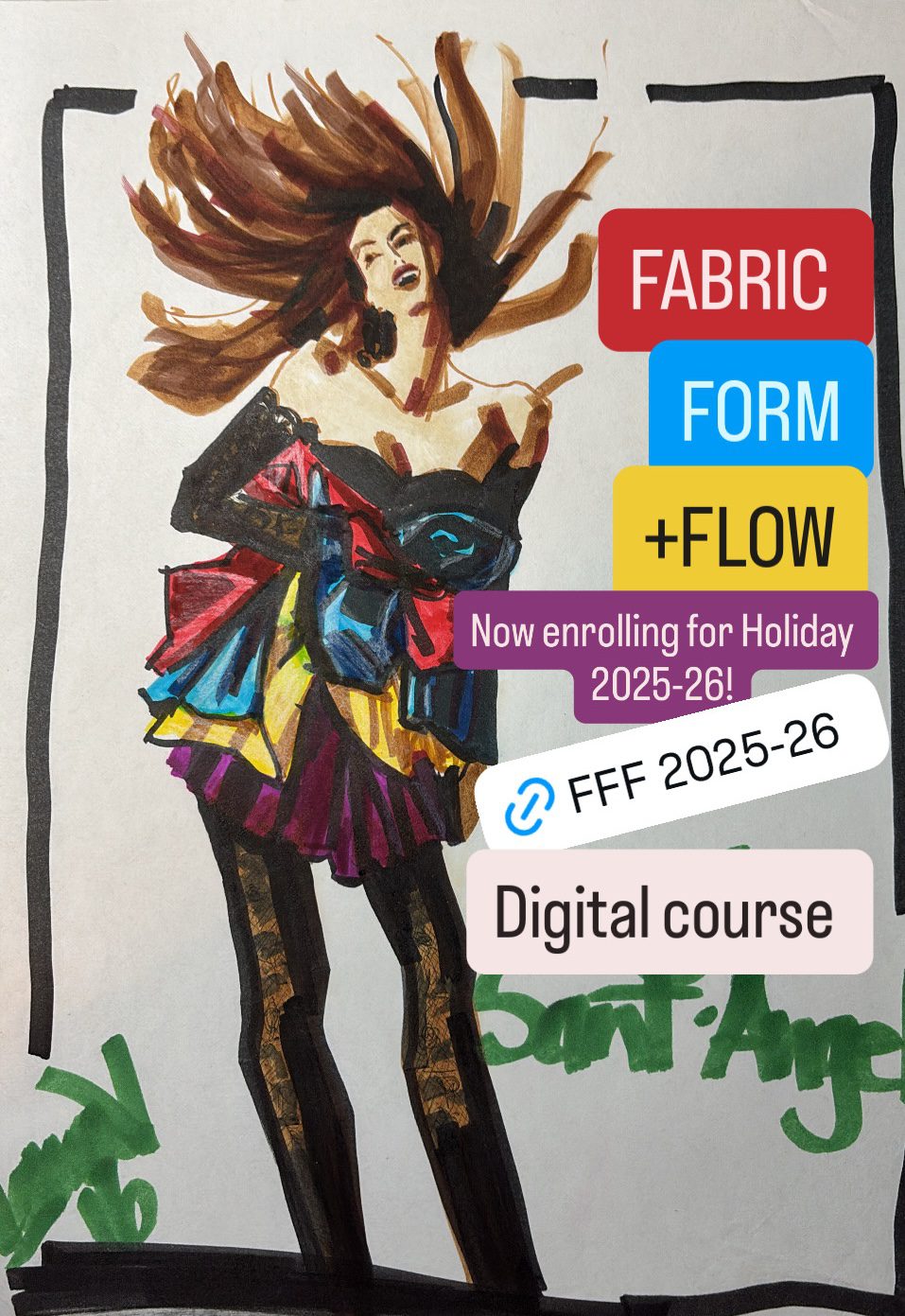
Right now the only pre-recorded class I have that works officially with markers (and gouache and digital to give you a whole overview of media for fashion illustration) is Fabric Form and Flow.
There is no doubt that gouache or watercolor is cheaper in the long run, even if you pay $10 dollars a tube, it will last so much longer and you can mix your own colors.
BUT if time is money, then markers can foot the bill sometimes! Only you can know what you need right now based on what you’re using them for.
AGILITY
You can learn markers. The principles among gouache, digital, and marker techniques are fundamentally the same. My course FABRIC FORM AND FLOW is verrrrry much about driving this message home in an empowering way!
For example, for the Lord and Taylor live event, marker was my only option. And to top it off, they made me use their branded paper which was bleeding through and soaking up all the ink!
I had to learn to use Copic markers for fashion (and other markers) when I started doing those live fashion sketching events at Lord and Taylor stores, private parties and retail events.
Markers are portable, quick drying, and versatile for hi-speed work like that, and each sketch an original, unlike a digital sketch which can be printed again and again.
Copic markers for fashion sketching and all KINDS of art just has been a tremendous buzz and trend.
I like that they are supposedly refillable, but I have never personally seen the refills for sale.
WHAT COLORS TO BEGIN WITH?
I started by purchasing some skin tones, beiges, greys, and black (the most important to start with).
To this day, the most important marker purchases I make are the super light colors because that’s how I can “sketch softly “ in marker before I add harsh or bolds shapes onto a the “mapping” sketch.
I got less expensive markers for other details, and worked Prismacolor colored pencils into my techniques to add texture and contrast by laying them over the marker work.
The one thing that is really interesting about Copic Markers for fashion is that they have a very crisp, hard chisel tip on one end, and a rubbery/soft brush tip on the other end.
I TOTALLY prefer the brush tip and how soft it feels on the paper.
Both are available for Android or IOS and I have on online course devoted to apps called ABOUT FACES. Check it out by clicking the “ONLINE COURSES” in the menu in the header!
Windsor and Newton Pigment Markers (now discontinued) or Chartpak I-D markers (Chartpak more toxic) have wetter, softer chisel tips for more flowing, organic feeling of fashion illustration.
Let me know what you think/ ask questions!
Love, Laur