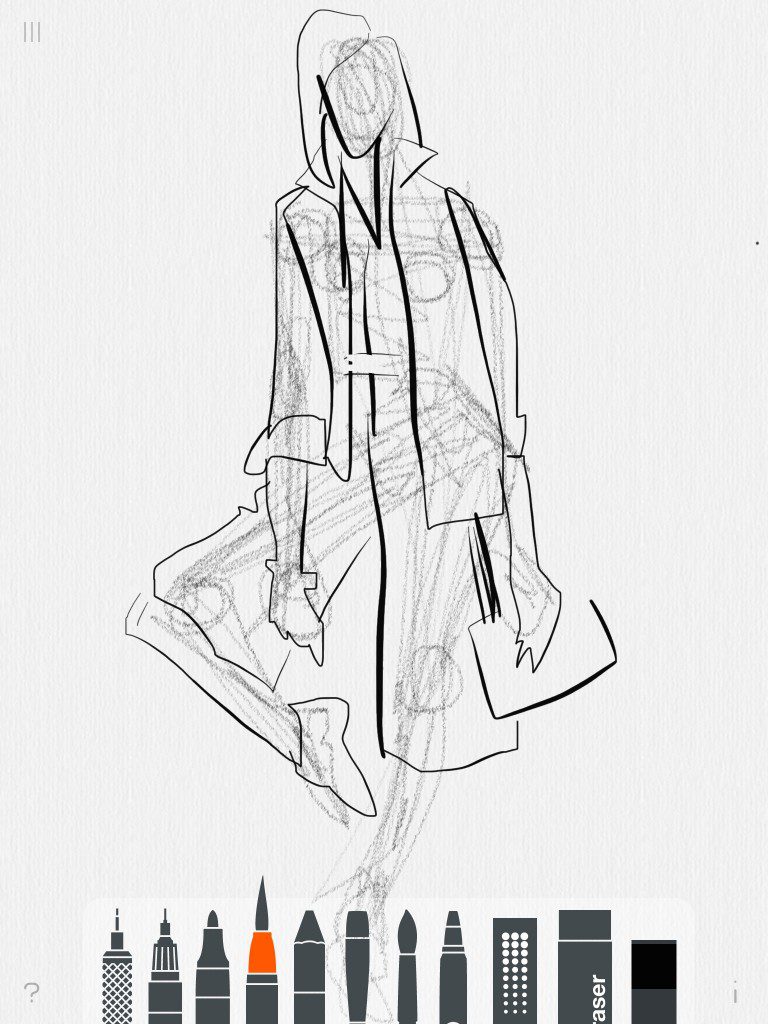
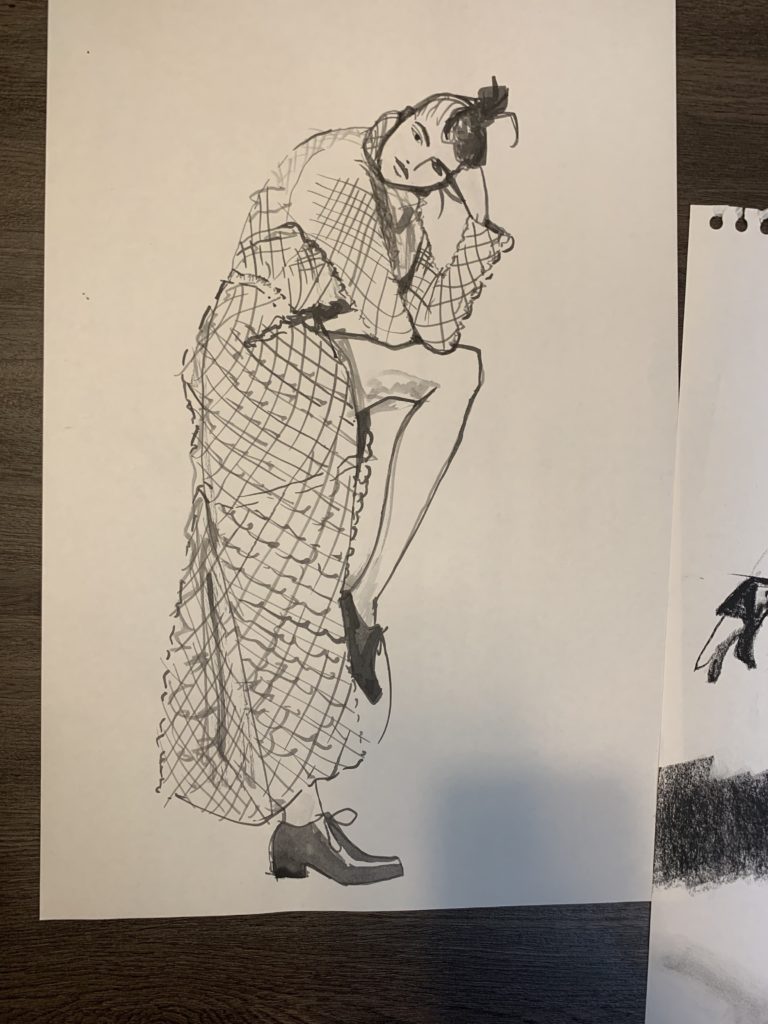
Let’s identify all of them?
- Skin: smooth,
- Hair: long smooth strands (yes they count)…
- Leather shoe: shiny and rigid,
- Quilted silk: has a thickness, a puffy pattern and lattice like grid, and sruface stitches.
- Shoe laces- flat, opaque strands
EMPHASIZING CONTRASTS
When I become aware and take this account, I can play up and feel into DIFFERENCES in texture and accentuate what each one’s character is when I render the fabrication.
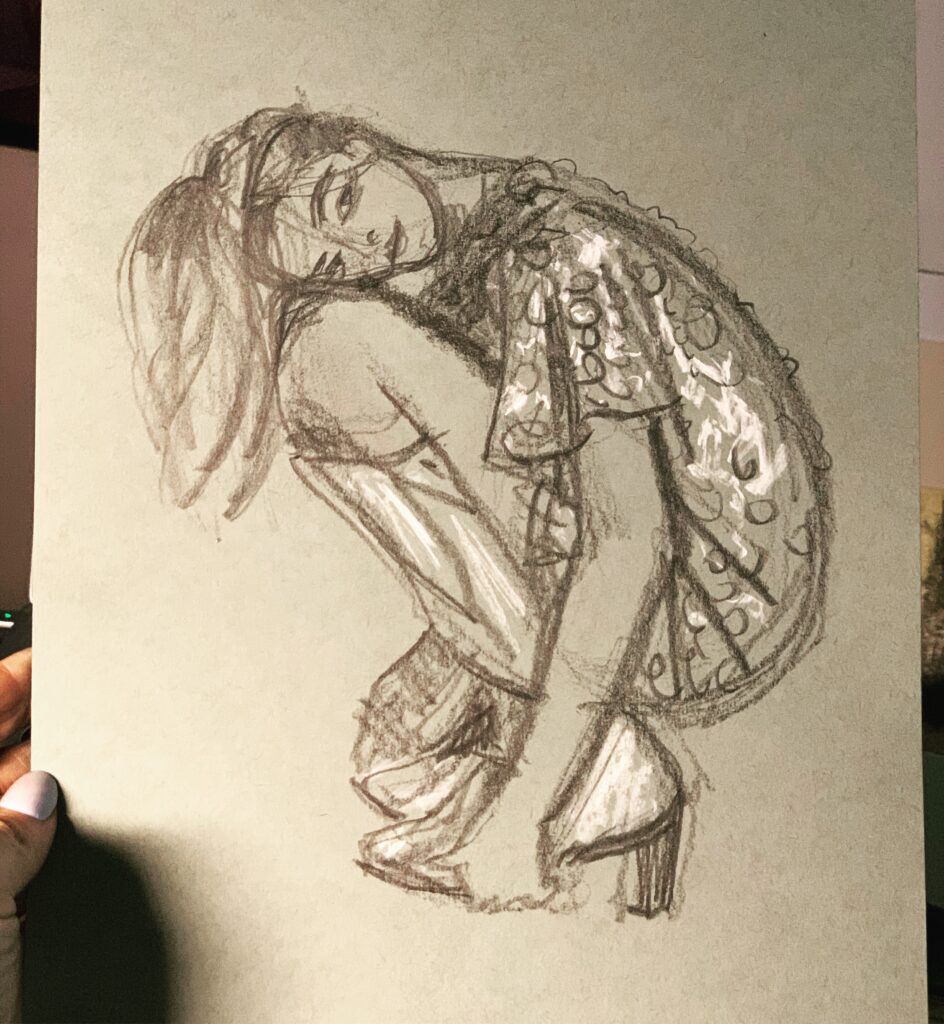
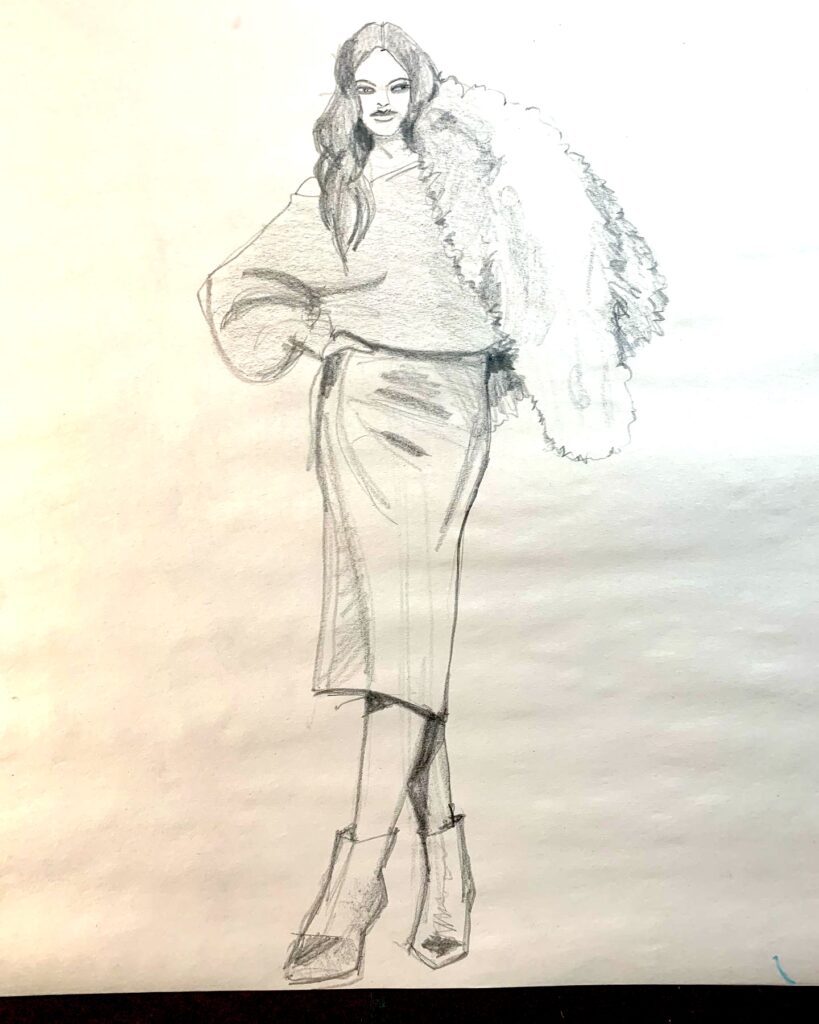
So, observing the photo of the model in the coat,…
- I zoomed in on the silhouette and high-shine effect of the shoes
- I captured the swirling movements of hair and shoelace strands.
- the minimal aesthetic of the shoes contrasting with the coat.
The QUILTING had several characteristics
- the relative stiffness of the hem
- the directional lines and scale of the lattice pattern and its visual effect on different areas of the body,
- The shadows cast by each little puff (a rhythmic effect),
- the coverage and sense of warmth surrounding the model,
- the not too thick thickness of the quilting and how it bends with the body bending.
Suddenly, there is this lively “cast of characters” interacting on the page (as a fashion illustration) and on the HUMAN (as fashion design concept)- it’s such a wonderful experience!
This is what we live for- the joy of fashion illustration.
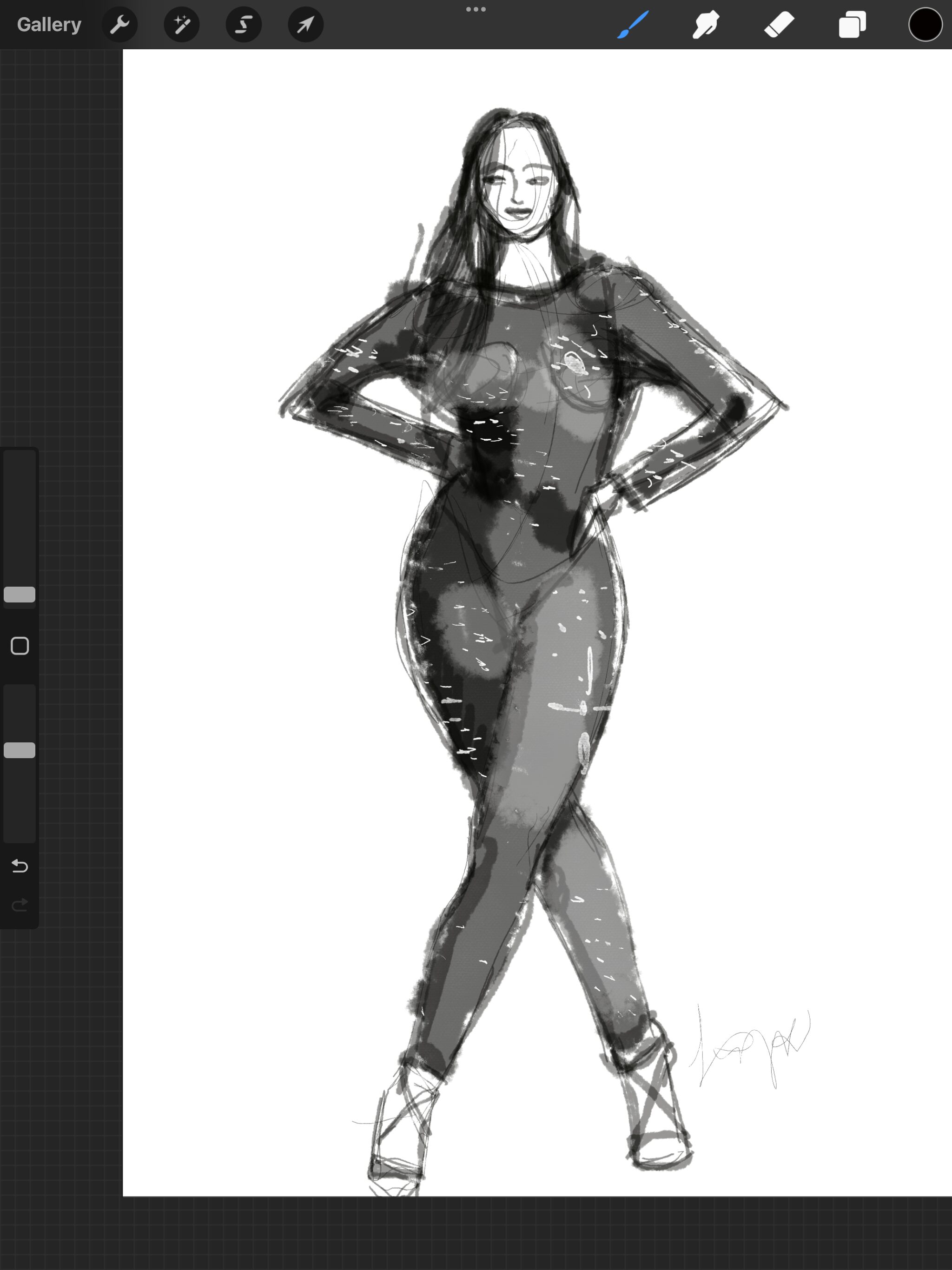
I map out the body first, so I know WHERE I am putting things, and THEN I lay those things out, one at a time, embracing each one with my love of fashion and design on the paper.
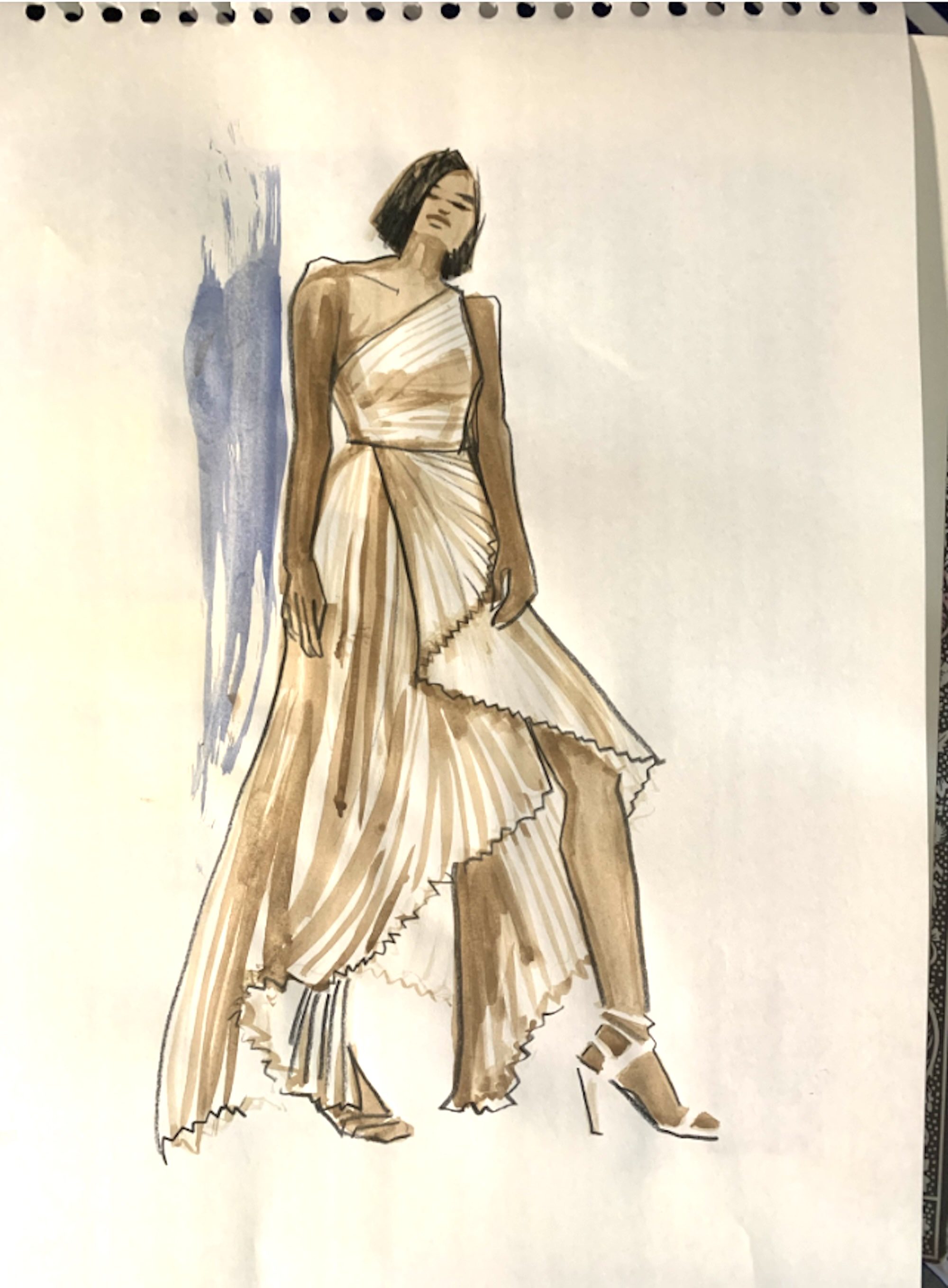
SURFACE TEXTURE VERSUS EDGES TEXTURES:
Every texture has two aspects.
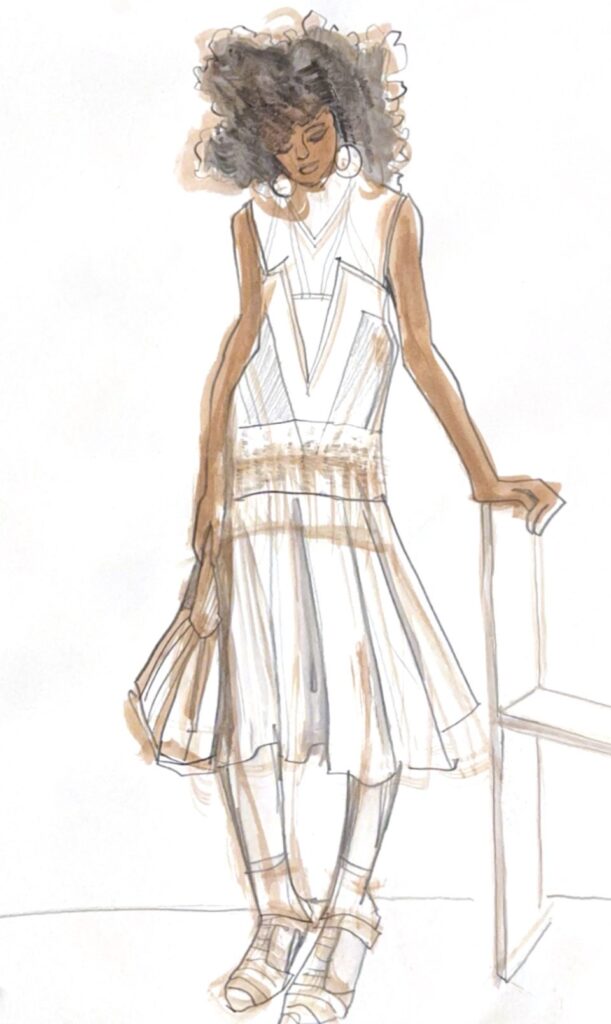
We sketch its surface effect of light and dark : see the accordion/ sunburst pleats above laid out in various saturations of brown wash of gouache.
We COMPLETE THE STORY of sketching texture by REITERATING the pleats where they show up in the CONTOURS and EDGES of the dress ( notice the infinite zig-zagging pleat edges through the hem here) as well.
That component is expressed here as a fine line that captures a pattern and scale of rythmic repetition, pleat by pleat.
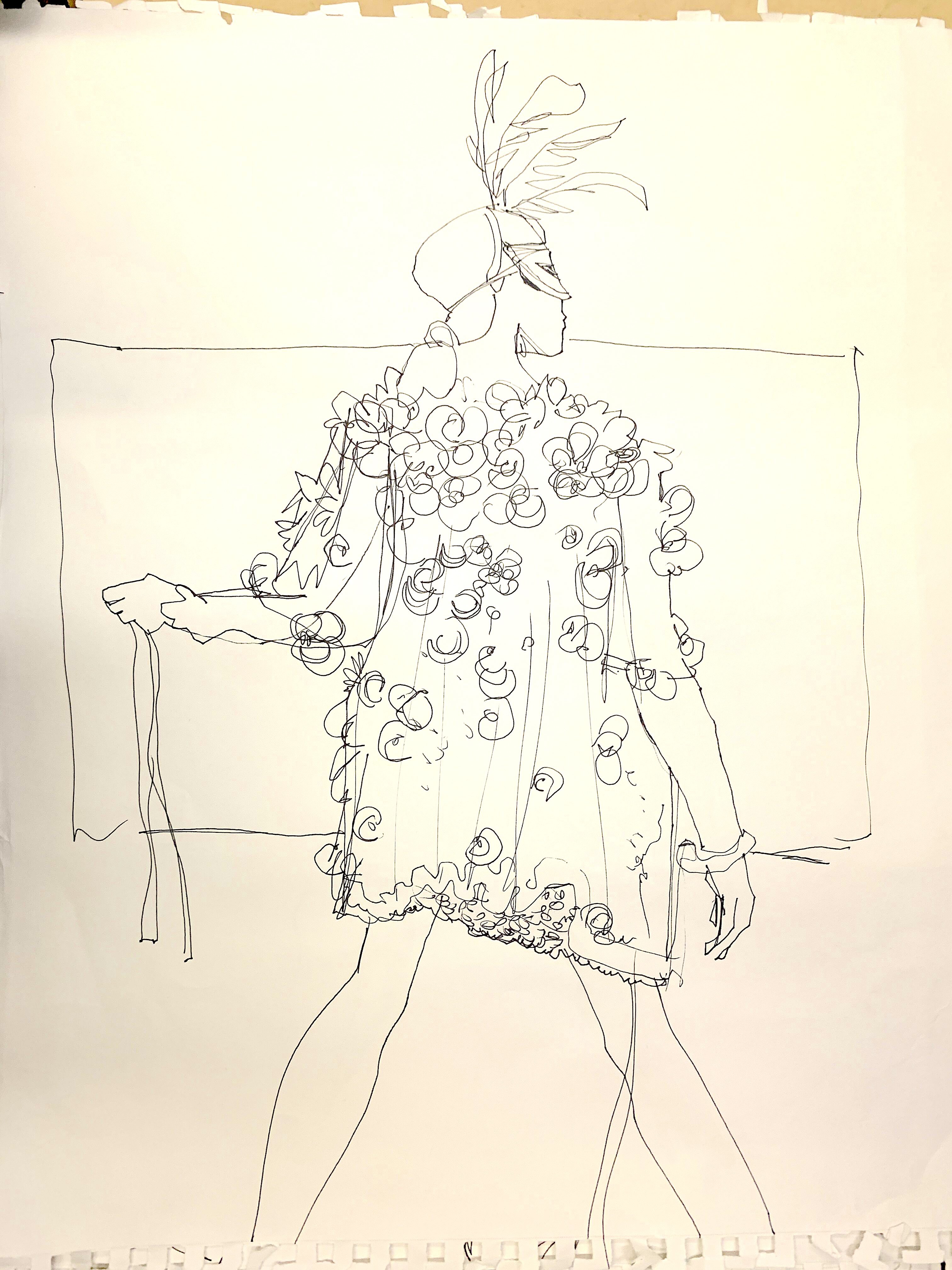
In Fabric, Form, and Flow, CREATIVE DESIGN with fabric rendering emerges AFTER we have internalized and embodied all of these characters by capturing them.
The original illustrations from research portion of the course is a type of meditation period that warms us up for the process of creative fashion design sketching around these elements! I discuss this more in Fabric Form and Flow, but I’m sure you are already getting ideas and ready to sketch, just like that.
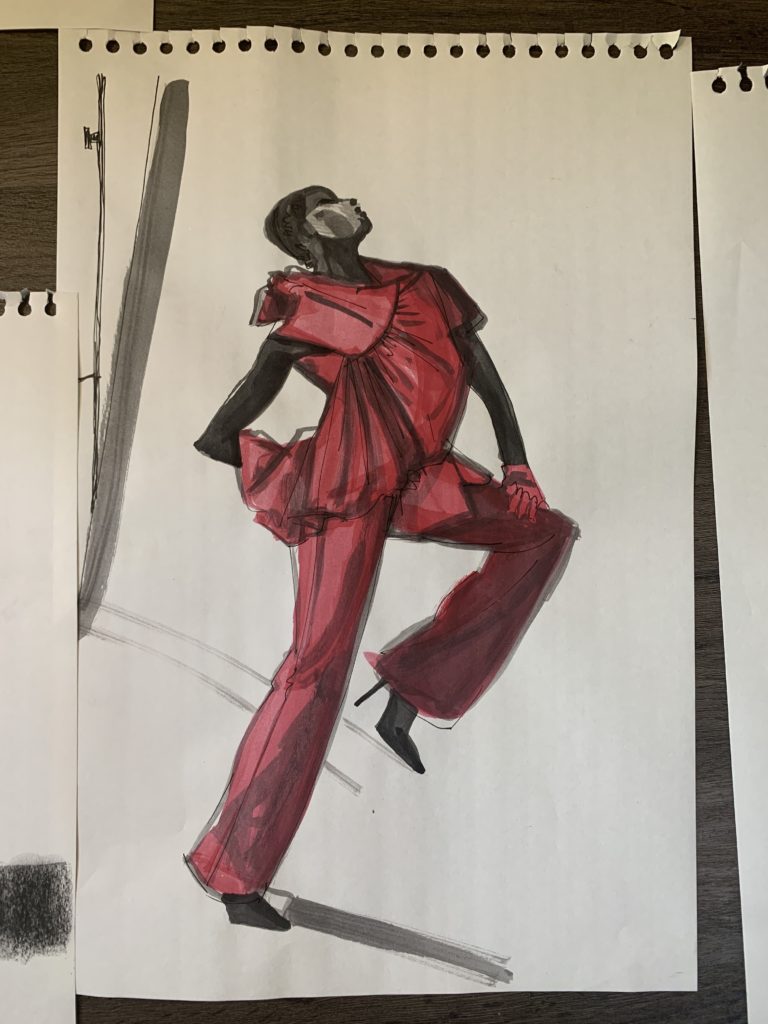
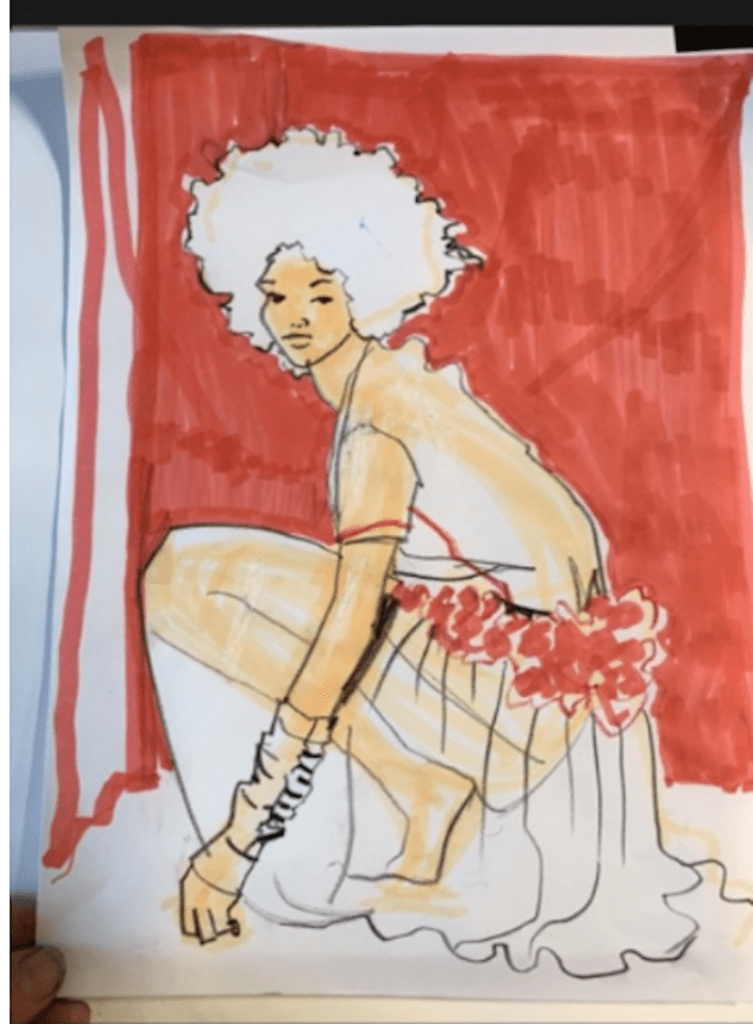
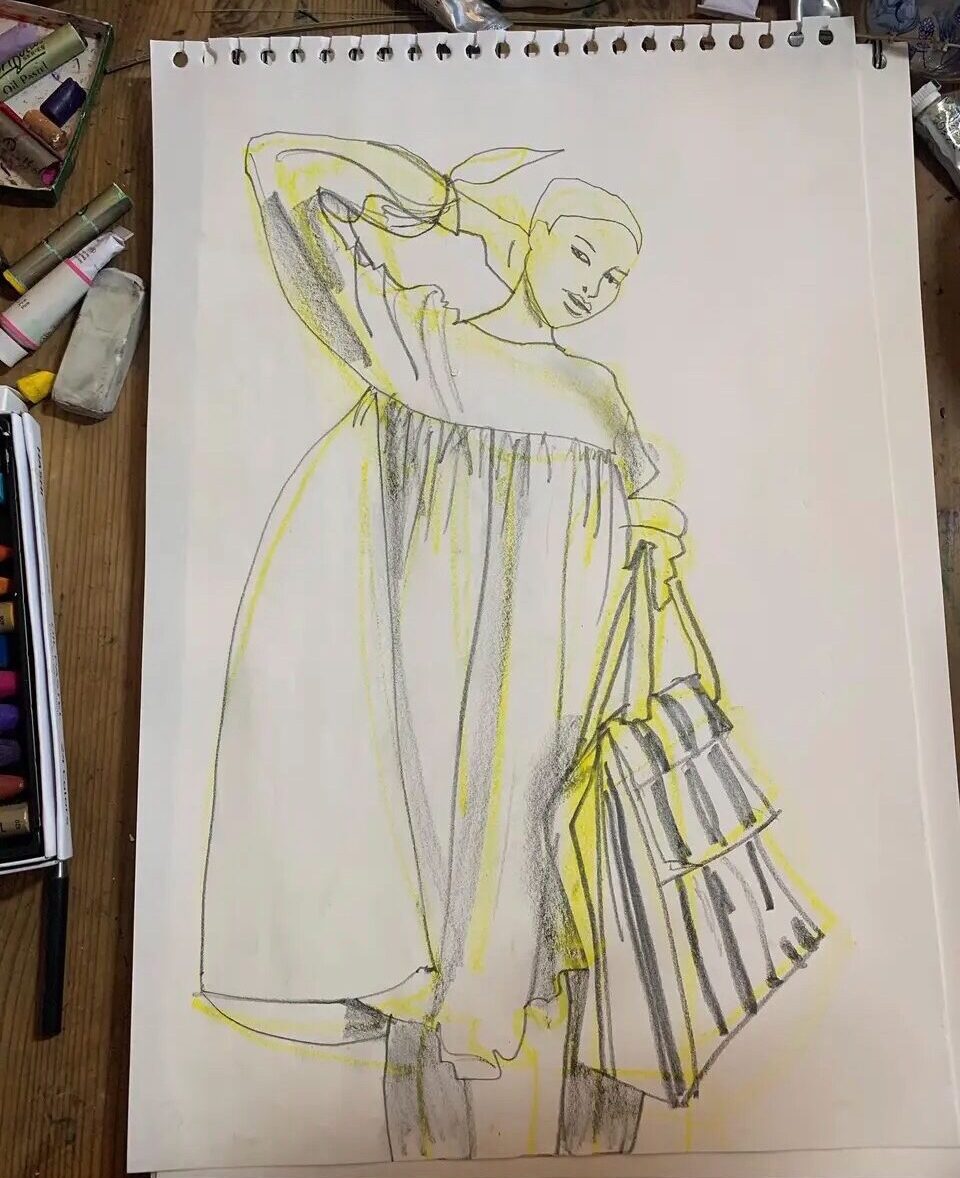
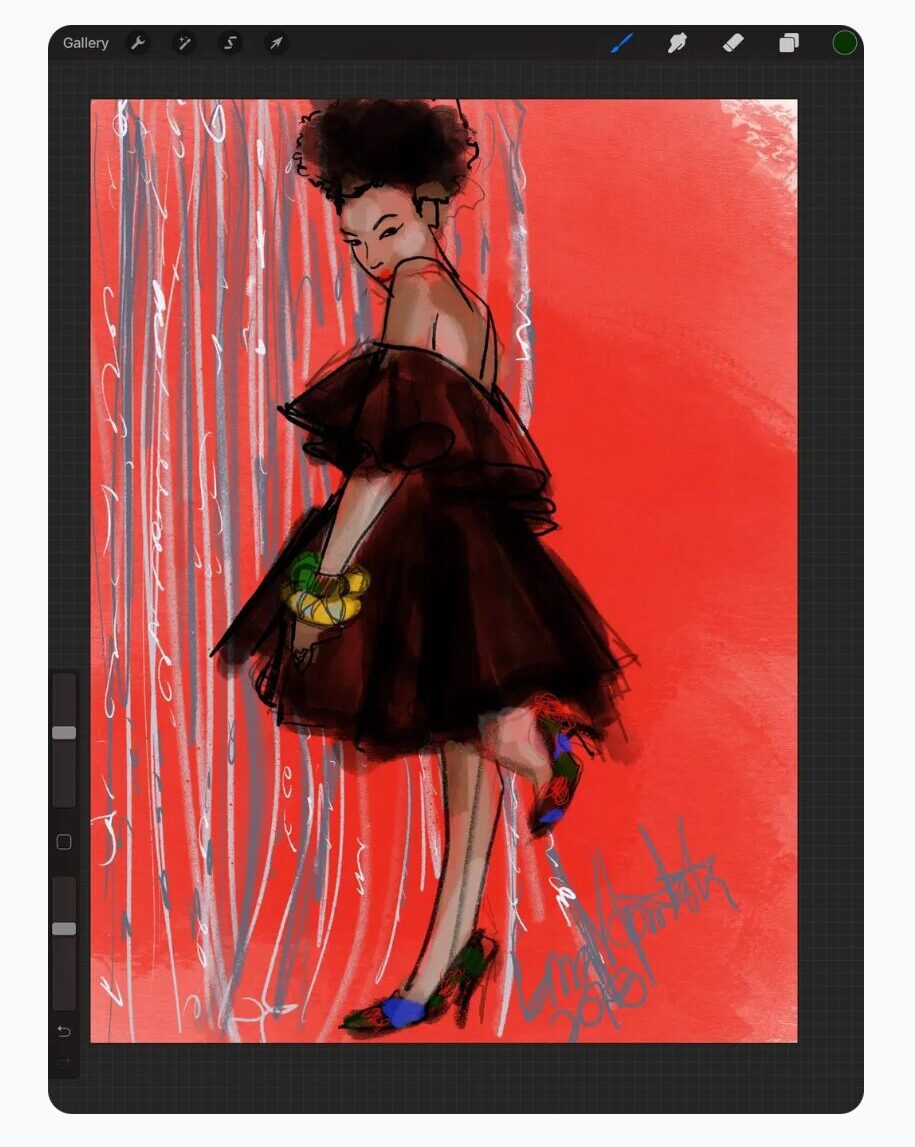
is different because the illustrations above and below it are LINE DRAWINGS without color. So much of the work I do with my clients is with the body. Look at the line drawings as opposed to the red taffeta ensemble above…and FEEL how different it FEELS compared to the line drawings!
The flat red gouache color filling (well, it was flat before I added shadows) makes a MUCH STRONGER STATEMENT about the QUALITY of the fabric, it’s stiffness, its reflective surface, its firmness (as opposed to a stretchy clinginess) through the way it responds to weight (its drape), the way it bends with the body, and the way it responds to the gathering details, and above all perhaps, its SILHOUETTE.
VELVETY GOUACHE
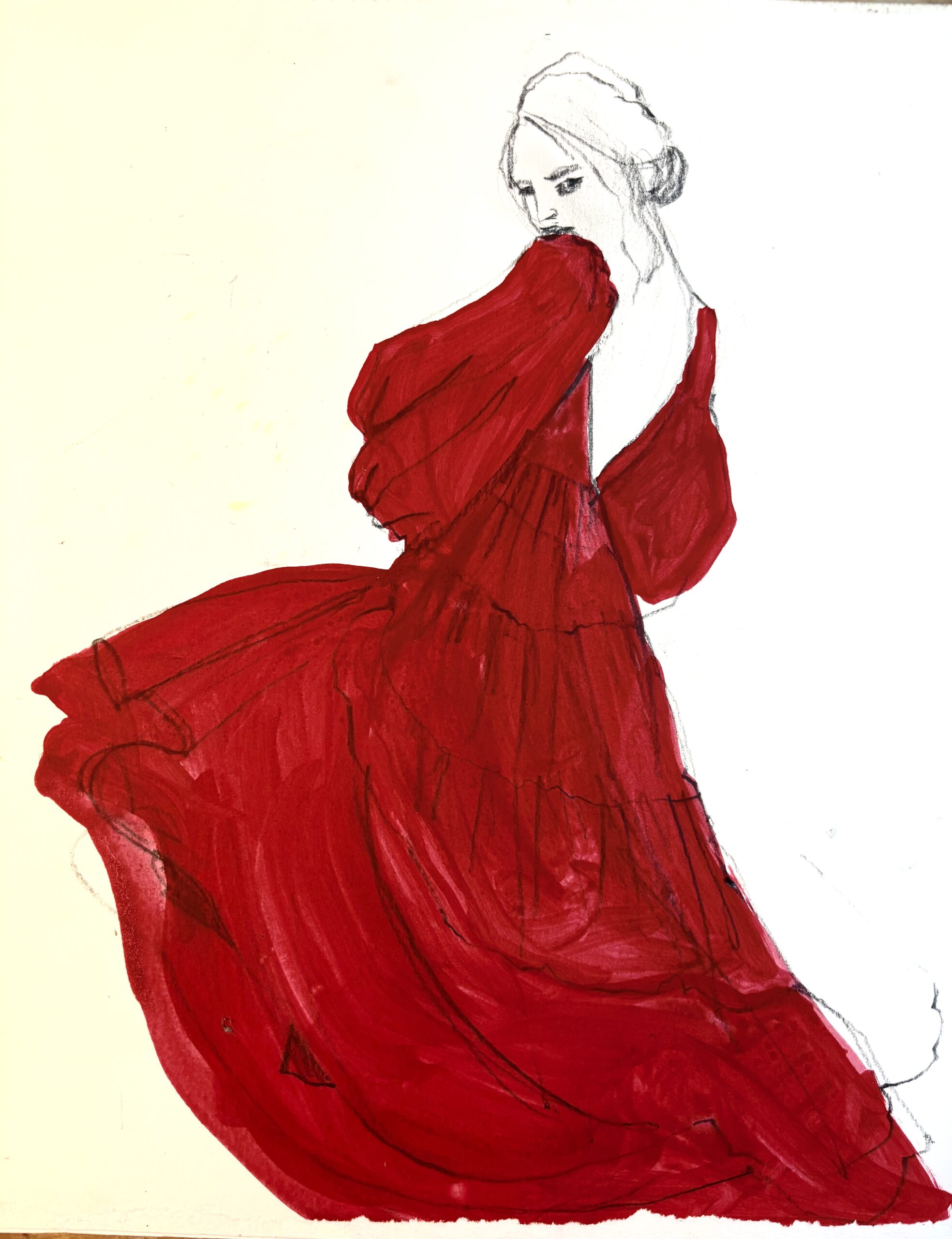
When I conceived of FABRIC FORM and FLOW, I knew that I wanted to create a class to focus on these key components:
- special fabrics textures (sheer, lace, satin, metallic, feather/fuzzy, leather-like, tulle, sequins, embellishments, etc etc… anything beyond the “every day”
- special silhouettes (shapes with “extra” drama (height, width, size, volume, shape, etc)
- rendering practice and exercises learning and practicing the language of special fabric surfaces
- various media exposures and experiences (gouache, digital, and markers all discussed and experienced) so you can capture the universal language, see what’s possible with each, and also see what tools attract you the most
- creative sketching processes that you will put into use right away as you take off designing your own unique group of designs branching out from all your new experience!
- the work flow of warming up, sinking in, and then taking off.
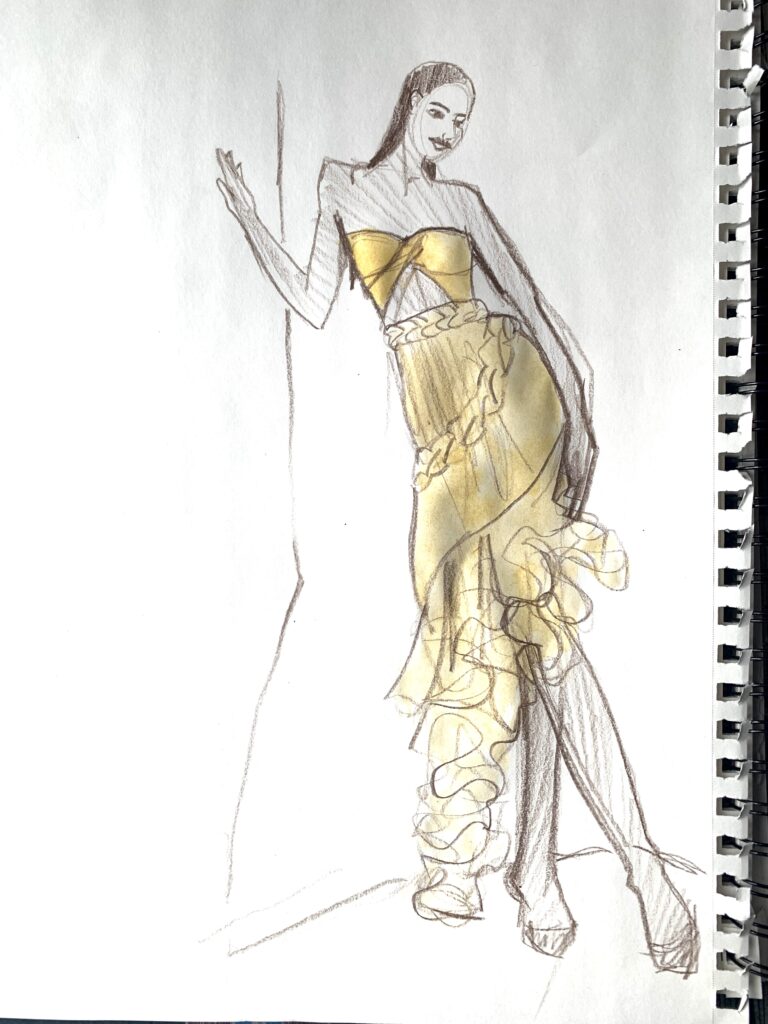
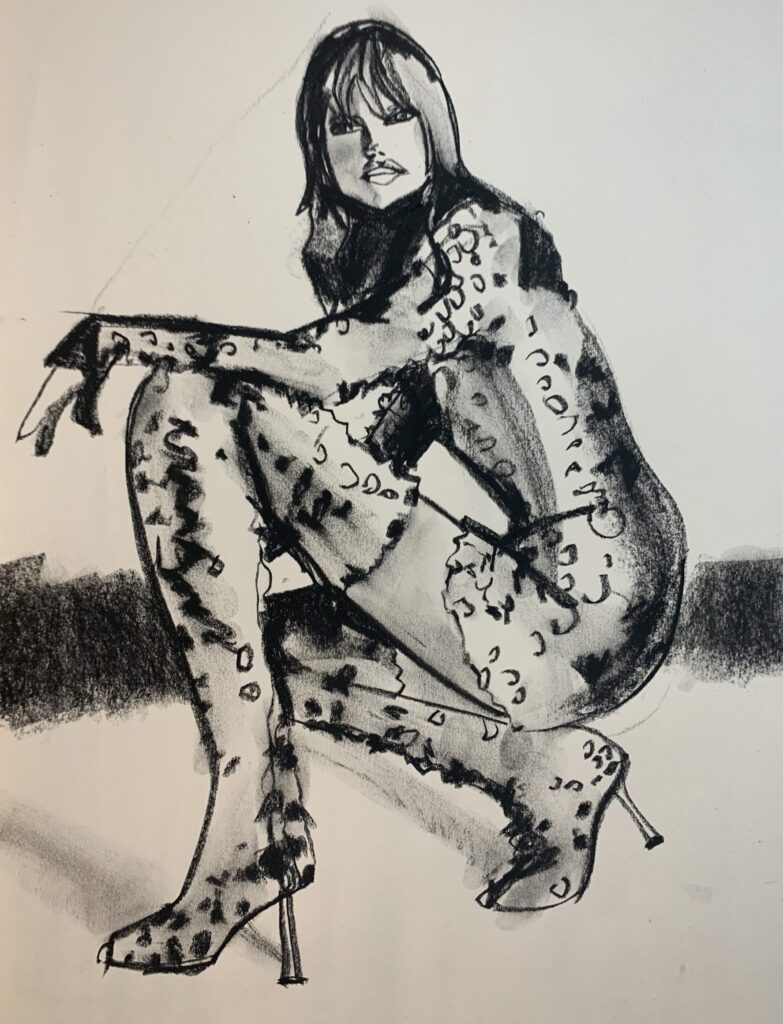
MATTE VERSUS SHINY
Always look for deep blacks or bright whites.
The darker the darkest tone, and the lighter the lightest tone, and the closer those two tones are to each other, THE SHINIER THE MATERIAL APPEARS TO BE.
I learned this in my early years as a metal and jewelry design intern at Barry Kieselstein-Cord in NYC.
When I lived in NYC, I always loved the Halloween parade because I noticed that people waited all year long for one day to experiment and wear that one thing they always wanted to…. to express themselves that one way that they just “couldn’t” all year long.
This is similar to what I experience at carnaval celebrations in Brazil, though carnaval is much more JOYFUL.
SPECIAL OCCASION FABRICS
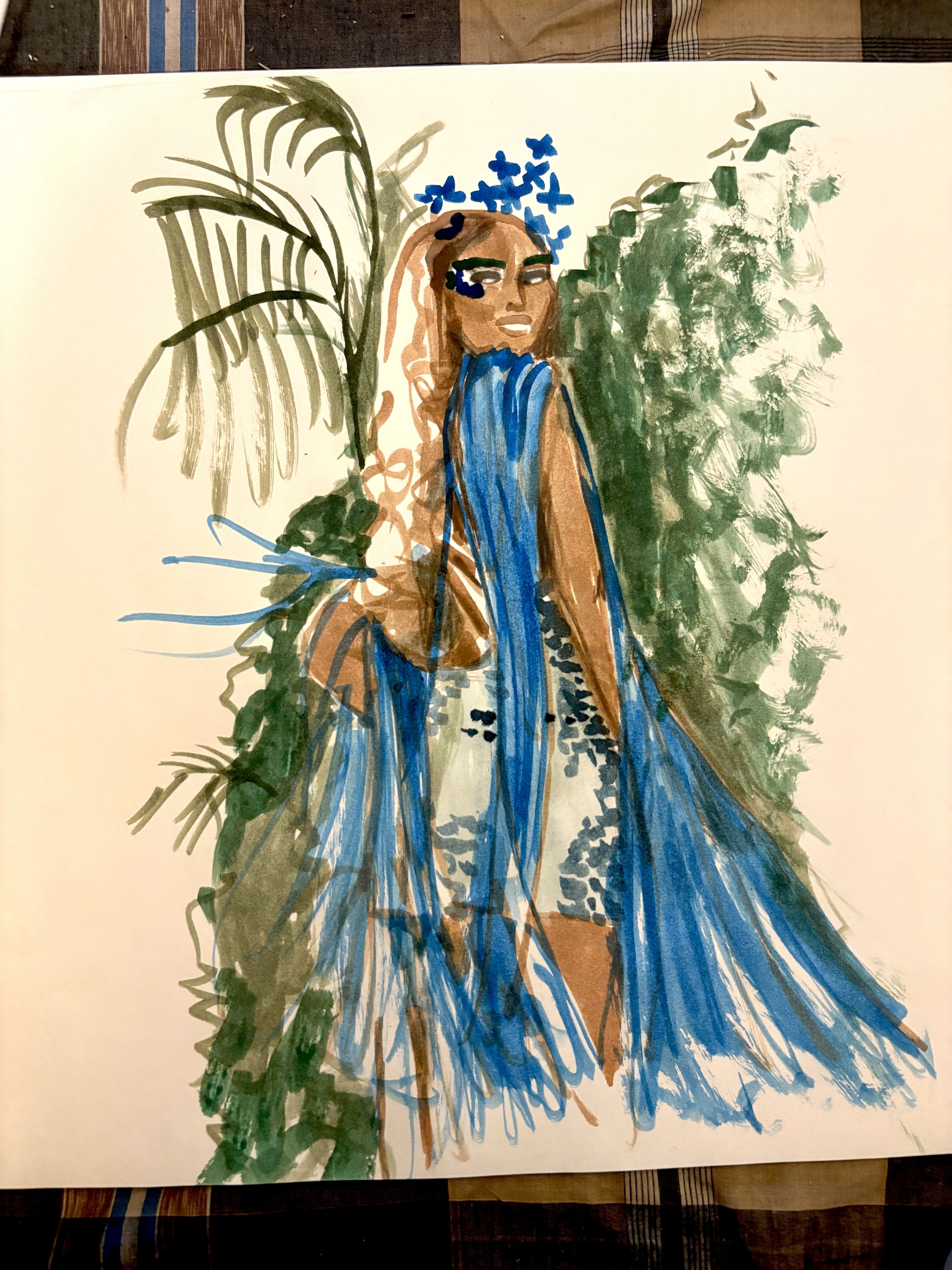
Later, I discovered Brazilian carnaval in its many manifestations throughout the regions of the country and again the same.
I became so in love with the flashes of light, color, feathers, fringe, embroideries, sequins, crochet, etc etc without end. The DRAMA and the OTHER WORLDLINESS that fashion, costume and adornment offers us.
The LIMITLESS CREATIVITY of humans in their creative expression! (My next book will be all about this)
THis is what FABRIC FORM AND FLOW speaks to. Even if you are all about couture gowns, that’s still exactly what I’m talking about.
SEQUIN, TULLE, SHINE, FEATHER
Below, I illustrated these two looks by AVOA- from Olinda and Recife’s famous street carnaval in Pernambuco, Brazil.
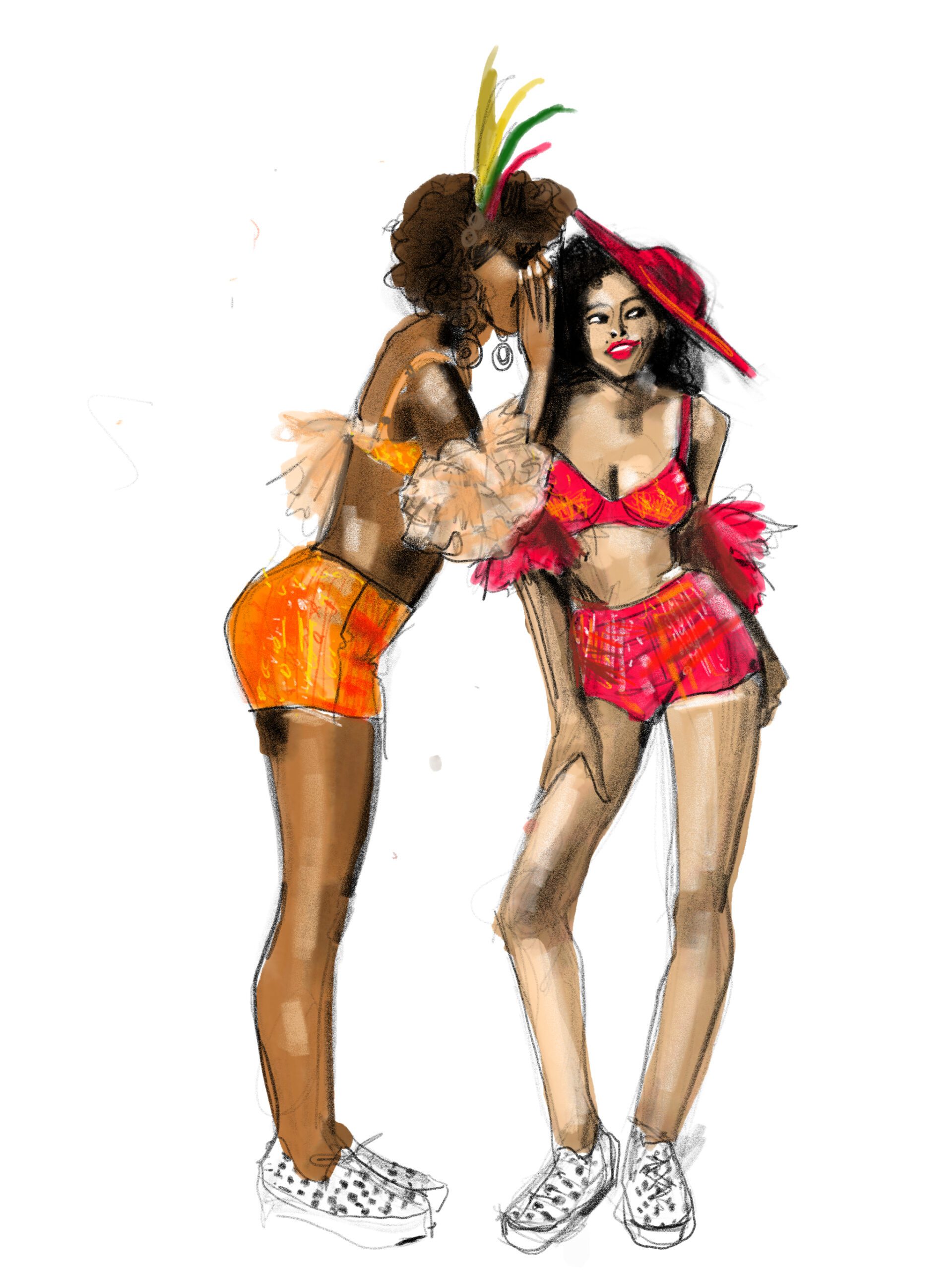
Below, oversize paillettes over a minimal, mini skirt and top, rendered in prismacolor pencil, a wash of skintone gouache, and a few strokes of green gouache from sketch sessions.
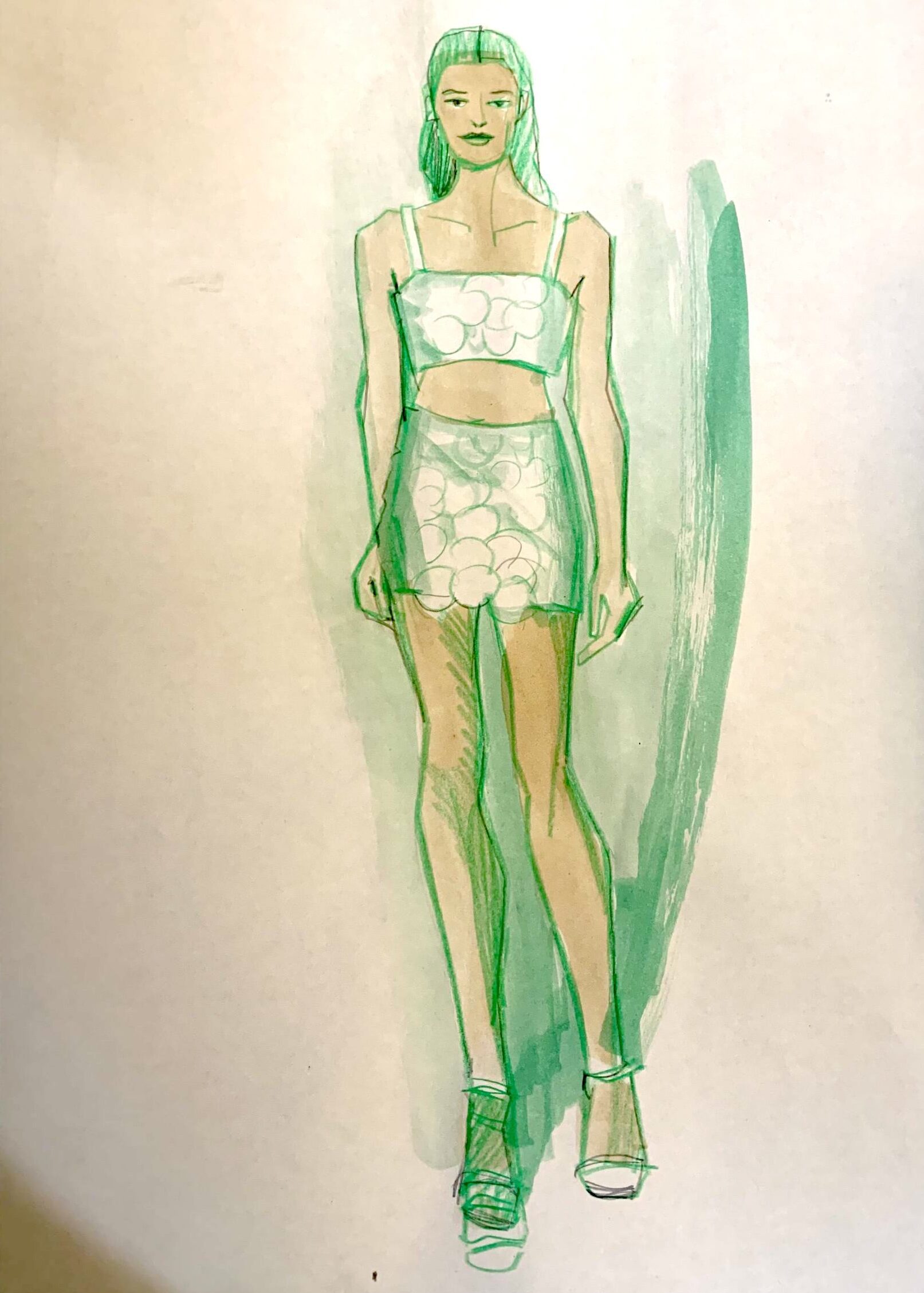
Again: see the texture, see the shine, see the silhouette, ….
see them all together, but also separate them and see and feel them them each separately !!