Just two weeks ago I wrote a blog post about movement, and when I was done, I couldn’t stop thinking about drawing fringe!!!
NOTHING MOVES LIKE FRINGE!!! My first prom dress had a beaded fringe at the hem… Like on the tiara below…

And when I think of carnaval in Olinda, ruffles and fringe come to mind immediately.

At the same time, I’m tickled to think how MOVEMENT, FRINGE, and DRAWING are all words with double meanings that mean a lot to me.
MOVEMENT: motion, or a collective change (A movement to create fashion without hurting anyone, from a place of joy , expression, and affirmation. )FRINGE: vertically hanging strands, a decorative element OR marginal, outside the norm.
DRAWING: making marks on a 2d surface OR pulling a resource out of another source
FRINGE IN KNITWEAR and CROCHET
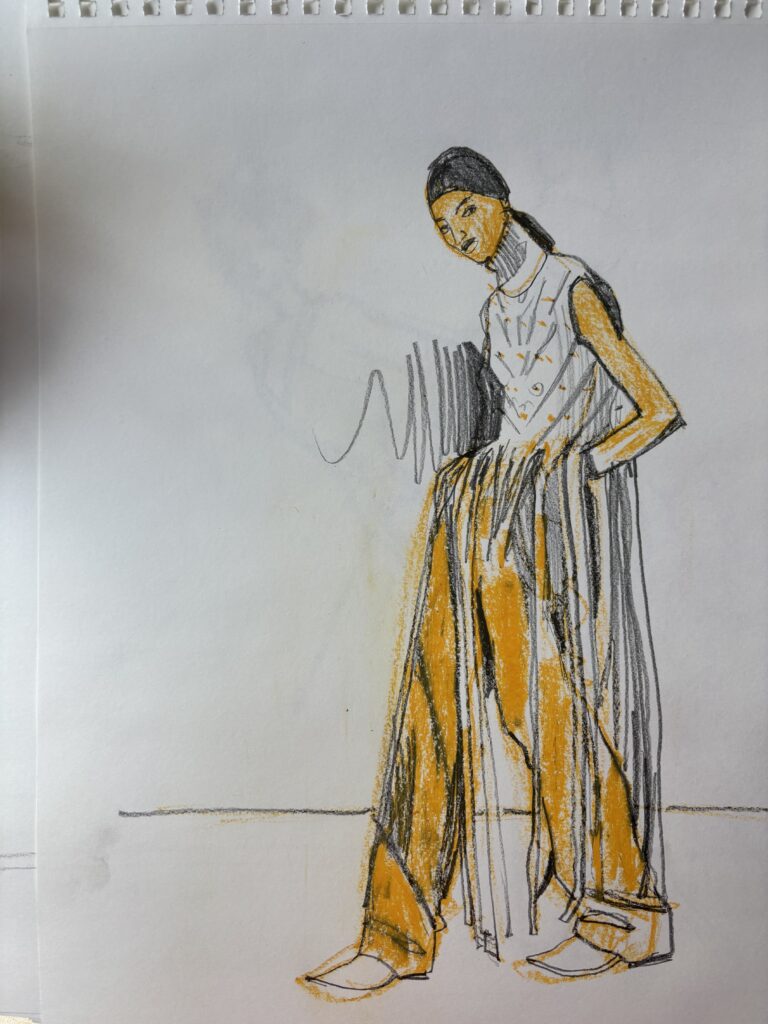
In the model sketch below, you can sense how I was loose and impressionistic, but made sure that I ESTABLISHED how wide and how long and how thick each strand of knit in this fringe was.
I love the FRINGES of fashion (the edges off of the beaten path, the voices less heard…… Fashion Illustration Tribe is a MOVEMENT…. a movement to take the best of the roots of fashion design education and creation, to express ourselves as WE ENVISION OURSELVES AND OUR WORLD and not how someone else tells us to.
TIMELESS, CLASSIC FASHION STUDY REVIVAL
While I watch (horrified) the university leave tactile, analog art behind to focus on digital skills, I felt more than ever that the pleasure in fashion creation is a physical interaction with processes, people, and materials, and not just something we do sitting at a computer, clicking.
I believe we want to touch, manipulate fabric, feel it, and, (back to movement) MOVEMENT in our bodies and our lives.
Don’t we want all of our senses to be involved in this act?
And DRAWING?? – our drawing ultimately draws out what is within us.
Drawing is a voice we have. Like writing, speaking, or dancing,
DRAWING is a voice too. It brings out what is within us, our hearts and souls.
And so, let’s go!
CARNAVAL COSTUMES: SEQUINS AND FRINGE

a fringe made from Long strands of ribbon from the epaulets add extreme drama and movement to this look! Just a few indications of light and dark establish the shine, length, and width of the ribbons.

In the digital fashion illustration ABOVE, I layered pink over red and literally just used long opaque lines to draw fringe. The opacity made it obvious that one fringe laid OVER the other.
Because I used a wide brush/ wide stroke, this was effective. But when using a pencil or something with a fine line, it can just look like spaghetti so we will discuss your options on this page:
THE WEIGHT OF FRINGE USUALLY FALLS WITH GRAVITY
As a fashion illustrator, what I would urge you to notice is how the pose has an “s-curve” to it– notice how full of angles and diagonals it is!
AND YET, notice how awesomely the fringe contrasts with that by falling straight down with gravity regardless of what she is doing with her body.
Like a plumbline.
(Straight or heavy hair also behaves this way)
FRINGE IS USUALLY CONTRASTING WITH OTHER ELEMENTS IN YOUR SKETCH!
This behavior of the fringe tells us about the fringe’s weight, etc.
WHAT TO NOTICE ABOUT FRINGE RIGHT AWAY:
- NOTICE HOW LONG YOUR FRINGE IS IN RELATION TO HOW WIDE I(proportion)
- NOTICE THE OVERALL SHAPE OF THE FRINGE
- NOTICE the CHARACTER of the EDGES of the fringe (contour skills)
- NOTICE where the fringe joins to the garment and analyze how it is attached.
- Notice/ analyze what it is made of.
- Notice the OVERALL shape and behavior of the fringe area , also..
- NOTICE the behavior, edges, and shape of individual strands.
- NOTICE whether the individual strands are highly visible and articulated, or whether they blend into a general shape or movment.
- NOTICE how light and shadow interact with the fringe (either on it or UNDER and BETWEEN the strands on it)
All of this information INFORMS THE WAY YOU DRAW.
Drawing KNITS with FRINGE trims
The fringe on the knit purse below is chunky and textural, an excellent reminder to lean heavily on contour drawing skills to describe the texture! Fringe is very common on knit and crochet designs to add not only decoration, but weight and stability to garments that might otherwise be too lightweight to “drape” over the body.


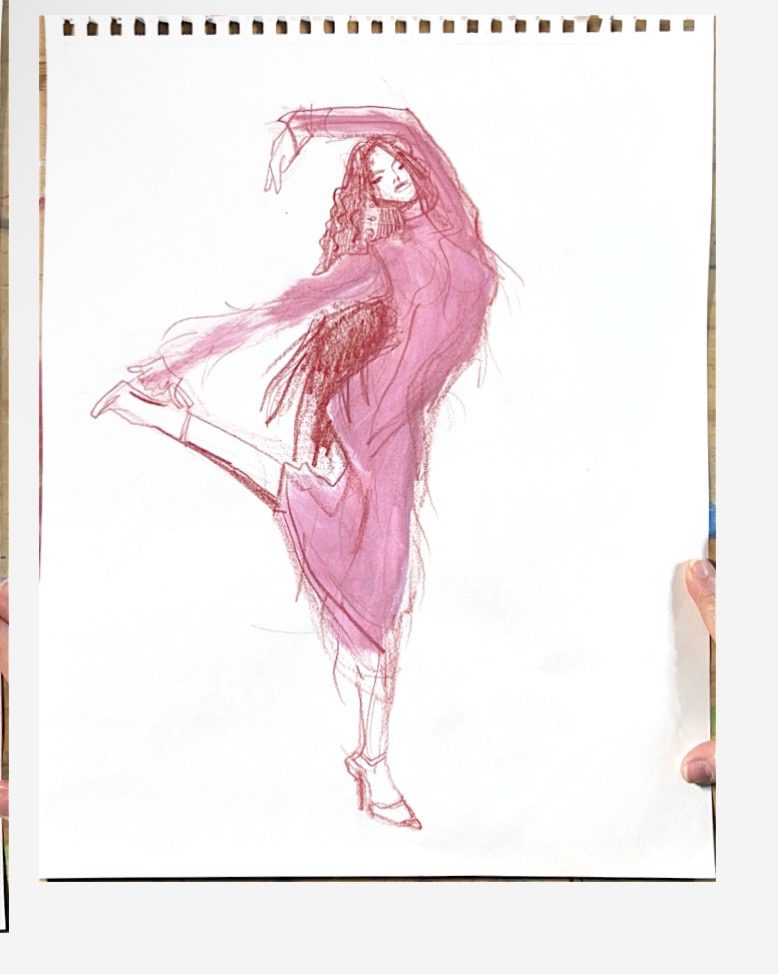
Here’s another quick pose- pencil-sketch from the live model drawing class I host every week. I used a smudge for the shading and left the pencil crisp in other areas. The fringe in this dress was applied to the hem and was braided into a trim that could be cut and applied. So I drew the band of the trim, showing how wide it was, and then indicated the length and directional movement I saw in the photo I was sketching from.
The “kicker” is that bit of fringe that is swinging out behind her. It creates so much movement and personality in the drawing! Meanwhile, in contrast, the fringe in the front of the pose just lays flat agains her skin of her calf. Similar to the first fringe in this post, this one is silky, thin, and flat, responding heavily to gravity.


This illustration above, I can’t remember if I was drawing fringe or fine pleats. I love that the side swoops up into a shirt-tail shape.
BE as explicit as you can in describing edges and shadows
If it was a fringe, I think I rushed through the sketch because the fringe doesn’t have any dark shadows or corners clearly expressing without a doubt, the character of fringe, as the vertical lines are all stuck together and no strands are flying free. Usually I will use deep shadow or line to separate at least a FEW of the strands in a fringe.
The color blocking and variety of textures on this carnaval-esque piece is so delightful though. Also done during a Fashion Sketch Group live Zoom session. Join us weekly!
DRAWING LONG, super SOFT KNITTED FRINGE
While the following rib-knit ensemble shows occasional fringed tassels as a design detail.


Love,

Author, The Language of Fashion Design: 26 Principles Every Fashion Designer Should Know on Rockport
Assistant Professor of Fashion Design, Parsons School of Design, NYC, since 1997
Singer
Mom